
I wouldn’t replace a perfectly functional water heater simply because it’s reached a certain age, but I also wouldn’t wait for it to start showing obvious signs of failure. Planned replacement of large appliances becomes a good financial plan when the cost of failing components, lack of access for easy repairs, or concern for the consequences of a failure outweigh the cost of keeping cash available.
If your water heater isn’t showing failure, the effects of water exposure are manageable and your household can cope with a service outage, continuing to use it while planning a replacement and saving for it can be a good financial plan. This is not an estimate that your water heater has a number of years of service left. This is an estimate of the uncertainty you can live with.
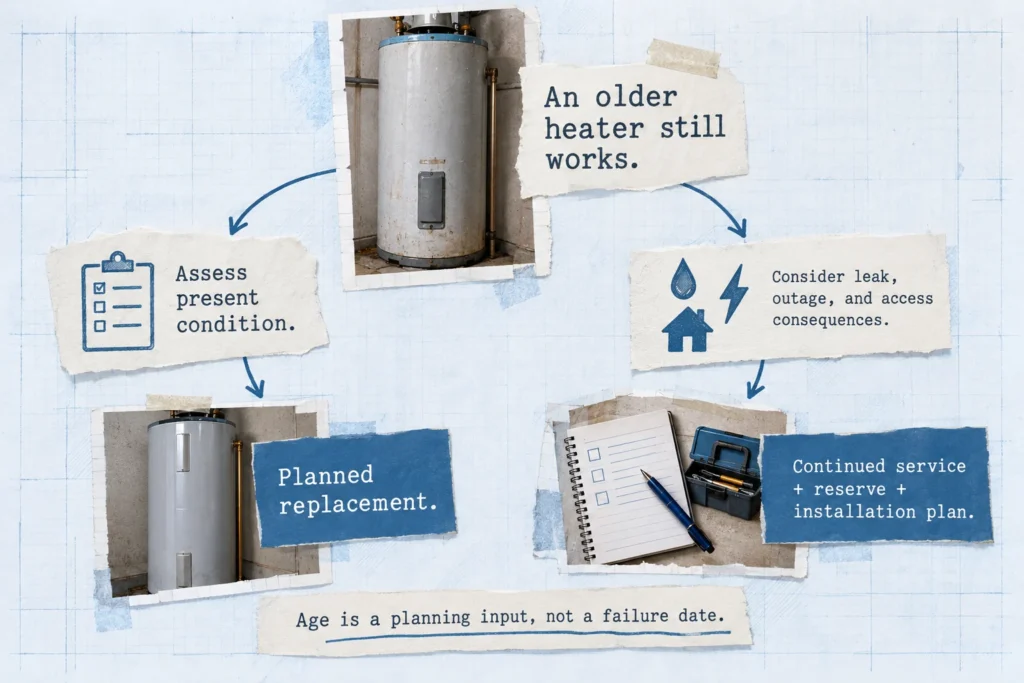
The birthday, the warranty, and the tank tell different stories
The Department of Energy’s Energy Saver states that storage water heaters have a service life of 10-15 years. This is useful to plan financially for a future replacement, but it doesn’t mean your water heater will fail next year or the next. Don’t use this estimate when planning for other water heating technologies.
| Information | What it helps you understand | What it cannot tell you |
|---|---|---|
| Typical service life | When replacement deserves budget attention | How many years this heater has left |
| Your exact warranty | Which costs might be covered, under which conditions | When failure will occur |
| Present condition and service findings | Whether there’s a current defect and what might be repairable | A guaranteed warning period before future failure |
Warranty coverage can be narrower than expected. An example is an A. O. Smith GDHE warranty that provides 6 years of tank and part coverage for the original owner, but states, “benefits for replacement of labor, including service, removal, and reinstallation are not provided.” Your terms could differ. I’d locate the model number, check the installation record, and review the actual warranty before assuming, “still covered,” means, “replacement will be inexpensive.”
Normal hot water delivery can’t reveal the true condition of the tank. Determining the cause of a problem would require an assessment of service, but the sources available to me give no way to transform an inspection into a reliable remaining life estimate. So, if a recommendation is to replace based only on age, I would ask, “what is the true reason for recommending replacement?”
Price the disruption, not just the appliance
Picture me in a different situation. I have delayed replacing the heater in an imagined house until I notice the hot water heater exit route runs through a narrow closet with shelving. I am somewhat annoyed, the tank still does its job, but getting it out is going to be a problem because replacing it won’t be a quick trip. Before getting to that point, I want to at least plan how it is going to be removed.
A heater in an unfinished utility area is a different financial situation from a heater in a finished living area. A cited manufacturer manual states the heater needs to be installed in a location where it won’t leak on other areas and lower floors. If that isn’t the case, the manual states a pan piped to a drain is needed to catch the leak. A pan alone, doesn’t means the leak will be contained.
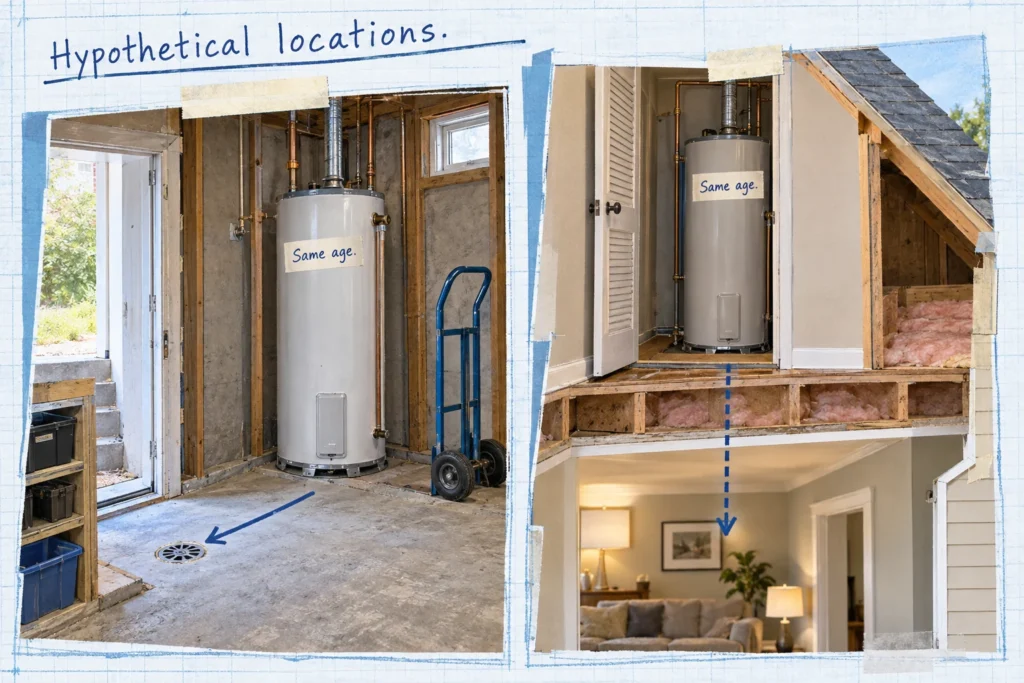
Look at what water can reach, consider the drainage route, and think about how quickly a leak would be noticed. Take into account factors such as frequent travel and completed finishing work in adjoining rooms. Also take into account stairs, and a household that can’t go comfortably without hot water for extended periods of time.
Judge the next repair, not the money already spent
A leaking fitting or heating element can be repaired, but a leaking water heater tank requires replacement. Water near a gas heater can be from condensation, and before you make a major purchase, you have to determine the source, not just condemn the heater because of a puddle.
For a diagnosed component problem, compare the next labor-inclusive repair price with the complete installed replacement price. Ask what the repair fixes, whether earlier repairs addressed the same fault, and what remains unresolved. Repeated spending without an explanation bothers me more than one clearly identified, reasonably priced repair.
Bills from the past are great for a history lesson, but that money is spent regardless of the decision you make. I wouldn't autofill a replacement threshold or assume a repair buys a specific number of years. The question is whether the next expense solves a known issue at an reasonable cost given the current condition of the tank and your exposure to another outage.
Get an installed price while you still have choices
A price for “a new 50-gallon heater” leaves too much unanswered. Per the FTC, multiple estimates are required and should include work to be done, materials used, completion date, and the price. For this purchase, I'd want the following unanswered questions resolved for this purchase to be my savings goal:
- Exact model, fuel type, tank capacity, and first-hour rating, the hot-water delivery available during a busy hour. Compare that rating with your household’s peak-hour demand, not gallons alone.
- Dimensions and route of removal, and clearance for installation and service.
- Work for gas and combustion air or electrical and disconnect, and what remains or changes.
- Drainage and relief discharge and expansion, condensate and air, if heat pump is chosen.
- Labor and exclusions, installed total, and the quote expiration, equipment availability, and expected time without hot water.
Requirements vary based on your location. For example, the replacement checklist in San Diego County addresses venting, combustion air, access, drainage, expansion and electrical disconnects. It is important to check with the estimator for the requirements in your location and be sure the work is reflected in the price.
Advance planning helps lock in equipment choices. According to ENERGY STAR, an appropriate heat pump model may require ordering and the conversion process may take longer than a standard replacement. If this is your preferred option, confirm availability and conversion work now rather than later.
Waiting needs money and logistics behind it
If you keep the heater, use the scoped installed quote as your reserve target. Subtract what you’ve already saved, then divide the gap by the number of months in your savings plan. That monthly amount is a funding goal, not a claim that the heater will last until the fund is complete. Ask how unresolved work would affect the total rather than inventing a contingency percentage.
Keep the model details, quote, and service contact together. Have the service provider identify the water shutoff and model-appropriate energy shutdown controls, explain when to use them, and leave that information where another household member can find it. Know your fallback for an outage and keep the replacement route accessible.
Reassess your decision to keep the heater after a new leak, a repair, an increase in household outage tolerance, and discovery of other work you didn’t budget for. If the quotation still says “venting to be determined”, this is the work I would consider next rather than the heater’s birthday.
Sources and references
- U.S. Department of Energy: Energy Saver: Tips on Saving Money and Energy in Your Home (2022-08)
- A. O. Smith: GDHE-50/GDHE-75 installation, maintenance, and limited residential gas warranty document
- A. O. Smith: Technical Bulletin 15: Condensation
- Whirlpool Water Heaters / American Water Heater licensed partner: Troubleshooting and Repair of a Standard Electric Water Heater
- County of San Diego Planning & Development Services: Building Self-Certification Program: replacement water-heater inspection checklist
- University of Florida IFAS Extension: Energy Efficient Homes: Water Heaters
- ENERGY STAR: Heat Pump Water Heaters
- Federal Trade Commission: How To Avoid a Home Improvement Scam