
Don’t immediately assume that you need to replace the pressure-relief valve on your water heater just because it is dripping. Water can accumulate for a number of reasons, including excessive system pressure, thermal expansion, overheating, and a valve that no longer seals. Before you purchase a new valve, check to see if any of these conditions exist.[1][3][5]
A small recurring drip without those warning signs calls for prompt diagnosis, not the same emergency response. There isn’t a universal drops-per-minute cutoff or a waiting period I can promise is safe. Never cap, plug, clamp, or otherwise restrict the discharge pipe. That would silence the symptom by interfering with the protection.[1][4]
The valve has two reasons to open
The full name is temperature-and-pressure relief valve, usually shortened to T&P valve. This valve can be designed to open with a temperature or pressure threshold. Both don’t necessarily have to occur at the same time for the valve to relieve. The standard for residential heating systems are typically 150 psi and 210°F. (Although the actual valve and heater specifications govern.) These thresholds are emergency relief settings, and not intended for household operating conditions.[3]
The distinction between emergency conditions vs. operating conditions is important, because water discharged for relief of excessive pressure, can still be hot enough to scald. Hot discharge water does not necessarily mean the valve opened due to temperature. Furthermore, looking at the pipe cannot help determine the peak temperature in the tank or whether the valve opened at the rated setting.[3][4]
Picture me in an imagined utility room, and I am shifting a cardboard box to get away from a puddle. I am annoyed, because one little drip has interrupted my evening. My first thought is to check the price of the relief valve. Then I see the heater is reheating after the last shower. My question becomes, what about the pressure while this tank heats?
A drip after a shower is a useful clue
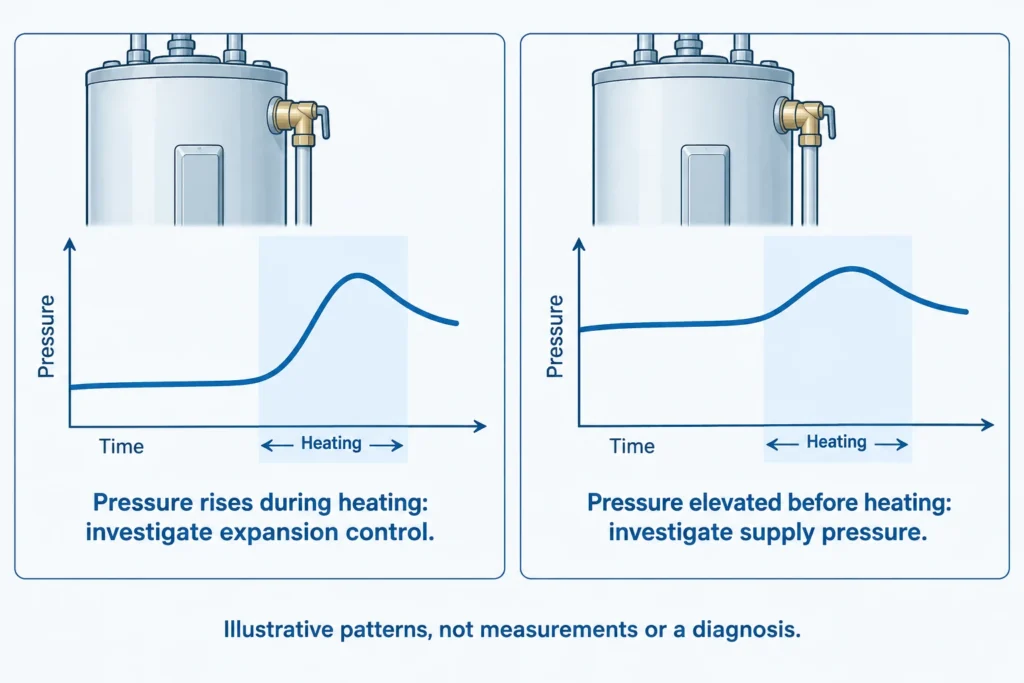
During the process of reheating, if the pressure in the tank is not reduced, the expanding water can push the relief valve to open. With all the fixtures in the system closed, there is nowhere for the expansion to go, and pressure can increase enough to make the relief valve open.[3][5]
A drip while the heater recovers means an expansion test may be warranted. That doesn’t prove it is. A valve can be fouled and/or damaged and more than one issue can occur at the same time. Continuous dripping doesn’t help determine the diagnosis.[1][5]
Without touching the outlet or operating controls, note when the discharge appears: during reheating, when nobody is using water, or throughout the day. From a dry, accessible position, check whether water is actually leaving the open end of the relief pipe rather than running down its outside from another leak. A photo, the heater’s model number, and that timing are useful information for the plumber. Don’t deliberately run the heater to reproduce the problem.
A regulator and an expansion tank do different jobs
A pressure-reducing valve controls incoming supply pressure. A potable-water expansion tank accepts the extra volume created by heating. Lowering excessive supply pressure may be necessary, but a regulator alone doesn’t provide a place for expansion water to go in a closed system. The T&P valve isn’t supposed to do that routine job.[1][3][5]
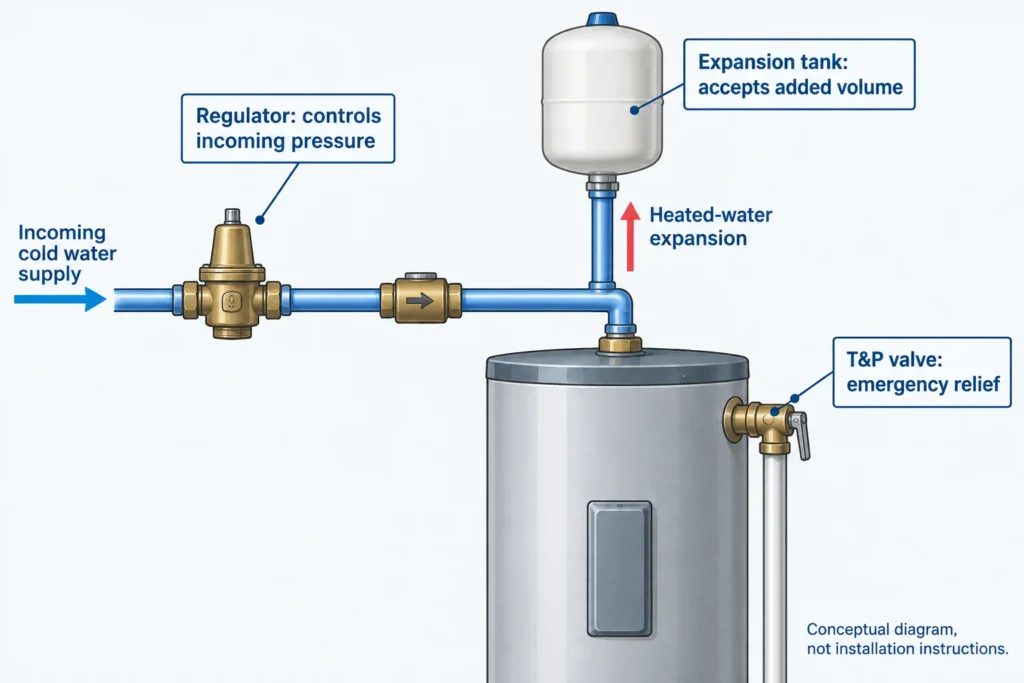
Three numbers often get mixed together here. The 2021 International Plumbing Code generally requires pressure reduction when building static pressure exceeds 80 psi, subject to its exceptions and local adoption. The cited A. O. Smith electric-heater guide recommends a regulator setting of 50-60 psi. A typical relief valve’s 150 psi setting is something else entirely. “Below the relief setting” is not the same as “acceptable operating pressure.”[1][3][7]
Already have an expansion tank? Its presence doesn’t prove it works. Incorrect air precharge, a failed bladder, or inadequate sizing can leave expansion uncontrolled. I wouldn’t accept its appearance, or a reassuring tapping sound, as the diagnosis. The cited Watts tank instructions require precharge adjustment with system pressure at zero, which is one reason I’m not suggesting you grab a tire gauge and start experimenting.[1][6]
Leave the lever out of improvised troubleshooting
Lifting the valve’s lever can release scalding water, and the valve may not reseat afterward. With an unfamiliar, already-dripping installation, don’t use the lever to see whether you can clear it. You haven’t established that the discharge route can handle the release or that the valve will close again.[1][2][4]
There’s no saying the lever shouldn’t be operated. The guidance from Watts and the A. O. Smith gas manual both indicate annual operation of the valve, with hot-water precautions and an unobstructed discharge route. Scheduled maintenance of a valve that is understood to be installed, versus an improvised test on a leaking one, is different. Have the plumber tell you the procedure to maintain the valve on the heater that was installed, and what to do if the valve does not reseat.[2][4]
What I’d want the repair to explain
Have the plumber tell you “What is the baseline pressure, what happens during reheating, and is expansion control working?” A normal reading before heating does not capture a peak pressure reading later. The investigation should also assess the temperature of the water if over-heating is a concern, and the condition of the valve and discharge pipe.[1][4][5]
Justification for replacing a valve is warranted when a leak is caused by a foreign object or damage and the leak is not resolved after correcting a pressure and expansion issue. The replacement valve must be of a relief capacity that is compatible with the heater. A higher pressure valve is not a “cure all” for a leaking valve.[1][4][5]
Be sure to obtain the results for the pressure test and how it was verified by reheating, before the service call is completed. During normal use, monitor the heater for recurring issues, from a safe location. A dry pipe is always welcomed, but a dry pipe backed by acceptable pressure behavior is what I would be comfortable paying for.[5]
Sources and references
- A. O. Smith: Residential Electric Water Heater Use and Care Guide, document 100264218, Rev. B
- A. O. Smith: Use and Care Guide, Residential Gas Water Heater with Inlet Damper, document 100323180
- Watts: Temperature and Pressure Relief Valves, PG-TP-ASME
- Watts: Reinspection Guide for T. & P. Relief Valves, F-DE 865
- A. O. Smith: Technical Bulletin 45: Thermal Expansion
- Watts: Installation Instructions, Model PLT-35 Potable Hot Water Expansion Tank, IS-PLT-35
- International Code Council: 2021 International Plumbing Code, Chapter 6, Section 604.8