
An acceptable home repair quote relates the contractor’s findings to an actual correction rather than patching the damage. I wouldn’t simply take your word for it, I’d want to verify what supports the diagnosis, what source-correcting work is included, what’s unknown, and how the work is to be verified. As far as the total is concerned, it’s never an answer to those questions, and a good itemized proposal is rarely an answer, either.
Imagine I'm at the kitchen table comparing two proposals for a ceiling stain, moving a cereal bowl aside to unfold the second page. One says “patch and paint,” the other says “investigate leak.” Finally, a couple of prices! I think, then a catch: neither tells me what a finished repair would include. It seems I need to ask each contractor to explain exactly what I’m buying.
Ask what finding led to this repair
“What did you find that makes this the likely cause?” I’d say, to begin. To verify that you have an understanding of the issue, you need a connection between what the contractor found and what he is recommending to fix. Was there a stain? Where was the stain? Is there a moist area? When does the moist area occur? What was inspected?
I know a photo may show a contractor’s “finding” but, without an explanation of the cause and effect relationship, the photo may not be helpful in diagnosing what’s wrong with my home.
I trust “We haven't opened the ceiling, so we can't assess the concealed materials” more than unexplained certainty. That tells you what's unknown. “We'll know when we get in there” leaves you needing the rest: where they'll open, what it costs, and what findings you'll receive. It's also worth asking what other explanation remains plausible.
If the cause is still unresolved, you may be buying investigation first, not a final repair. Give that smaller job a defined access area, price or spending limit, documented findings, and a stopping point before further work. Include temporary closure or protection, too. An open ceiling shouldn't become leverage for an immediate decision.
Three different jobs can hide behind “repair”
Separate source correction, damaged-material work, and cosmetic restoration. They may all be necessary, but they're not interchangeable. For moisture and mold problems, EPA guidance specifically includes fixing the water or moisture problem as part of judging cleanup complete. A fresh finish isn't a substitute for that work.
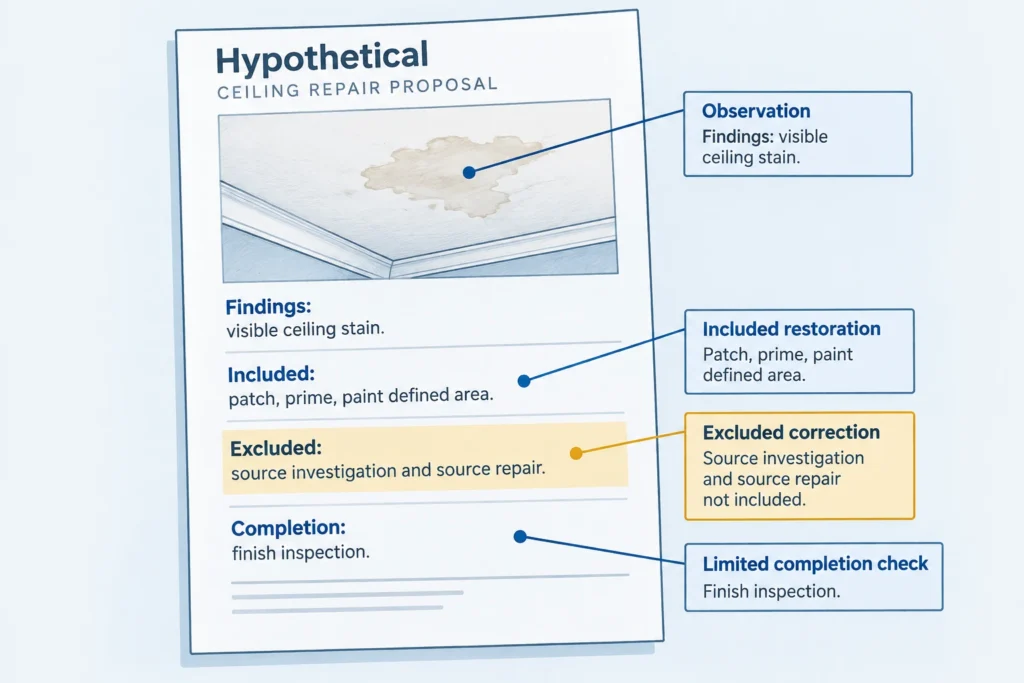
| Proposal wording | What it buys | Missing commitment to clarify |
|---|---|---|
| Patch damaged ceiling area, prime, and paint; leak work excluded | Finish restoration | Who has corrected the source, and what damaged-material work is included? |
| Open a defined ceiling area, inspect, and provide findings; repairs priced separately | Investigation | What protects or closes the opening, and how is subsequent repair authorized? |
| Correct the documented source, replace specified damaged materials, and restore the listed ceiling area | A linked repair scope | What concealed conditions remain excluded, and what completion check is included? |
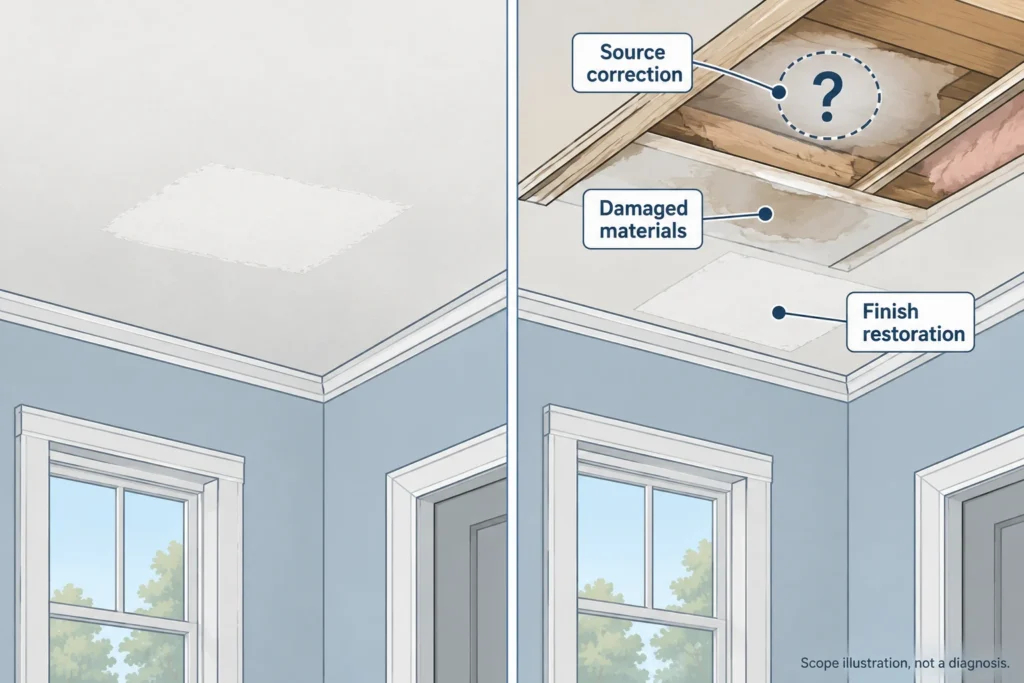
A finish-only restoration may be completely appropriate. The issue is an unknown or unresolved cause. If there are multiple trades, find out who is doing what. Who is fixing the source of the issue? Who is addressing the damaged material? Who is closing the opening? Who is handing off the work?
Bring the proposals onto the same page
The FTC suggests that written proposals include an explanation of the work, materials, completion date, and cost, and that consumers seek explanations for large differences in proposed costs. I'd read the descriptions before totaling costs. A lower cost may mean the buyer will be left purchasing part of the job somewhere else.
- Correction and materials: Consider the component, location, quantity and extent of the repair. “Repair as needed” doesn’t specify the extent of the work that the cost is buying.
- Access and protection: Costs of opening ceilings and walls, protection of finishes, and temporary cover to protect other parts of the job may be additional costs.
- Disposal and restoration: Costs to remove debris and the extent of finish restoration should be identified. Painting a small area of a surface isn't the same as painting the entire area, and like trim and landscaping, may not be included.
- Permits and inspections: Identify the permits and inspections required and who obtains them.
- Timing and coordination: The proposal should provide a completion date and identify the work dependencies, like the drying of painted surfaces or inspections.
A detailed breakdown of materials, permits, and a warranty may be required as per California’s contractor board. Though legal requirements for contracts vary by state, the FTC notes contract requirements vary by state.
Hidden damage needs a price process, not a guess
A concealed-damage exclusion may not be automatically problematic; however, I would be concerned with an exclusion that leaves the buyer in the dark about how the next cost will be determined once a wall is opened.
Agree on what discovery would trigger an additional charge, the documentation you will receive, and what will be in the change order. The price could use agreed unit prices, labor and materials with stated rates and markup, or a new fixed proposal. The important thing is to have the changed work, cost, schedule, and payment effects and the change order agreement before you authorize the change. Also be sure to include an agreement of who will protect the opening while you consider the price.
Advance written change order approvals are my recommendation, not a claim that all states have similar laws to California's.
An allowance is part of the priced agreement, your reserve is not. The proposal should define the allowance and state what happens to any leftover funds or to funds if the work costs more than the allowance. The proposal can also state what the work will be if the allowance is not sufficient (a label can be used to refer to this).
Agree on what “finished” will look like
I'd want “finished” to mean more than “looks better.” Have the contractor name the completion check, who performs it, and what result counts as acceptable. Depending on the job, that could mean checking the repaired component under relevant operating conditions, documenting drying, or completing required inspections. Photos before concealed work is covered can help show what was done, but they aren't a performance test.
Settle how those deliverables connect to completion and payment before signing. New York's attorney general advises waiting until work and required inspections are complete before final payment. Outside that state's guidance, the useful lesson is to negotiate clear milestones, not to disregard an existing payment agreement.
A completion check tells you about work completed, and terms in a callback agreement tell you about work to be done. Make sure to get any warranties in writing, and be sure to include the terms and conditions, coverage, and duration. Keep in mind that just because a symptom returns, it doesn't necessarily mean that work completed was inadequate or incomplete. There could have been a misdiagnosis, or it could be due to a totally separate failure.
It is important to remember that just because symptoms have not returned, doesn't mean the work completed was acceptable.
Intermittent trouble may also need later observation. EPA's moisture guidance includes revisiting the affected area when assessing cleanup, so for that kind of job, “keep an eye on it” needs a specific change that should prompt a callback. A useful completion check can support acceptance without promising that no symptom will ever return.
If your proposal has left you with these doubts, this is what I would send: “Please include the terms of the completion check and callback agreement, and any other unresolved work, as well as the source support and the cost of the completion check.”
If, after this, the causes still aren't supported, I would ask for the scope of the investigation first.
Sources and references
- Federal Trade Commission: How To Avoid a Home Improvement Scam
- California Contractors State License Board: Learn About Home Improvement Contracts: What Is a Contract?
- California Contractors State License Board: Contracting for Success
- U.S. Environmental Protection Agency: A Brief Guide to Mold, Moisture and Your Home
- New York State Office of the Attorney General: Home Improvement Fact Sheet