
You shouldn’t repeatedly reset a GFCI that trips. The GFCI detects an imbalance between the current going out and the current returning. Often times, current can take an unintended path and the GFCI is detecting that. The cause for that imbalance can be a moisture related problem, bad wiring, a faulty GFCI, or an appliance. I wouldn’t pick a replacement part for the GFCI based on that symptom alone. A reset brings the power back, it doesn’t solve the problem that caused it to trip.[1][5]
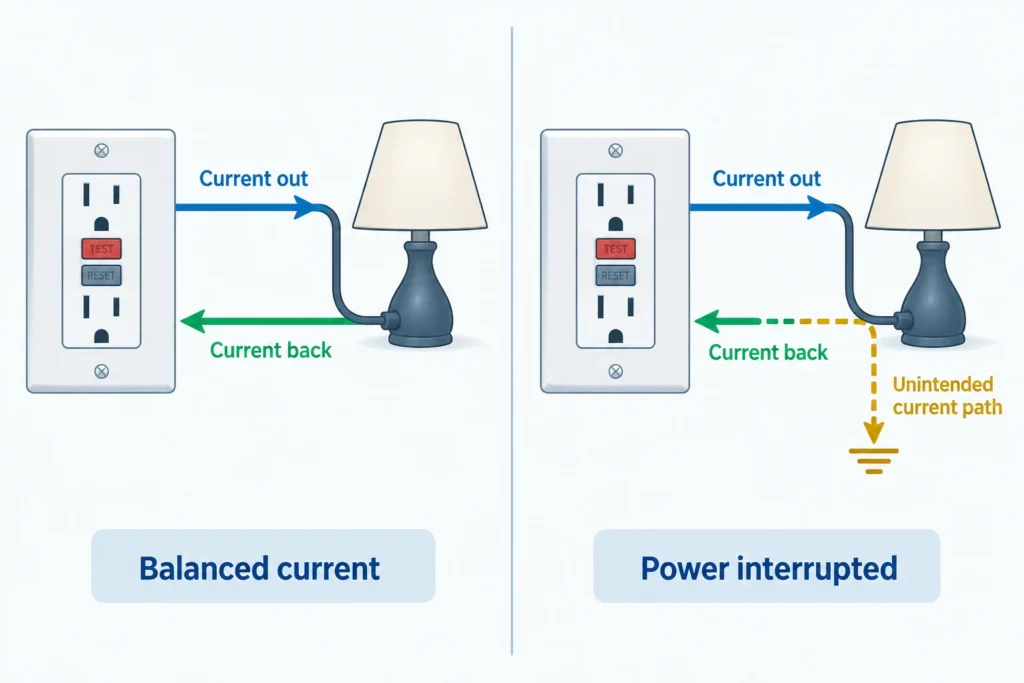
It’s watching current balance, not counting appliances
An imbalance in the current is what a GFCI is designed to sense. Adding up appliance wattages will not help explain a GFCI trip.[1][6]
An AFCI protects against unsafe arcing. A GFCI does provide protection against an overcurrent, as does a breaker, and some devices are combination devices. The type of device in your panel matters and you should treat it as an overload situation.[2][3][6]
Picture me in an imagined morning scramble: my hair is wet, the bathroom outlet is dead again, and I’m already late. I’d be irritated, with that reset button offering a very convenient distraction. Instead, I’d leave it tripped and jot down what was running before the power disappeared. A delayed morning is annoying. Mistaking restored power for a repair is the decision I’d want to avoid.
The problem may be beyond the outlet with buttons
It’s easy to overlook this, but an individual GFCI receptacle can provide protection for a group of outlets, including outlets without TEST or RESET buttons. Losing power with protected outlets tells you nothing about what is downstream. You can’t assume that because a receptacle does not have buttons, it is not connected to protection. You should look for visible buttons or protection labels to determine what is protected with the outlet.[2][5]
Also, not condemning a receptacle because RESET will not latch is also a good idea. Certain models of Leviton SmartlockPro, for example, will not let you reset if the power coming in is not present, the LINE and LOAD connections are reversed, or if an internal test fails. You have no way of knowing that from a button, and colors of indicator lights have different meanings on different models.[6][7]
Use the pattern you’ve already seen
You don’t need to make it trip again to give an electrician useful information. I’d bring what you already noticed:
- What appliance was operating before previous trips, including equipment at other affected outlets.
- Were trips to the circuit breaker due to weather? Was there a leak? Where did the water come from?
- Were there recent changes to the electrical circuits? Did trips to the circuit breaker start after recent electrical work?
- Whether the device tripped immediately or not, after steps already taken.
An appliance being on when the trip occurred is a lead, not evidence that it failed. You can’t reconnect loads or move the appliance to a different outlet to test your theory. Same with trips occurring after a rain. That raises a moisture question and doesn’t tell you where water got in or if there is water damage. Confirmed water damage changes the response, keep the equipment out of service pending a qualified evaluation. The ESFI says that water damaged receptacles and GFCIs should be replaced and that looking dry isn’t a reason to test them.[4][5]
A scheduled test is not another troubleshooting reset
CPSC, for a serviceable device that’s not wet or damaged or tripping repeatedly, suggests testing at least once a month after initial installation and after a power failure.
Its prescribed check uses a lamp: with power on, TEST should turn the lamp off, and RESET should restore power. If either part fails, stop using the affected outlet and arrange investigation. Self-test models from Leviton still require a monthly manual test.[1][5][6]
It’s important to distinguish functional testing: a successful test does not provide an explanation for recurring trips nor does it indicate a reason to continue to reset it.[1][5][6]
When arranging service, ask the same thing: “What finding points to the appliance, the protected wiring, or the GFCI itself, and how will you check the repair?” It may be justified to replace the outlet, but I’d want to hear the same for the trips. After the correction is made, request the service provider perform the model-appropriate functional test and check the appliance or circuit, and not just demonstrate that power has been restored.[1][5][6]
Sources and references
- U.S. Consumer Product Safety Commission: GFCI Fact Sheet
- U.S. Consumer Product Safety Commission: CPSC Guide to Home Wiring Hazards
- Electrical Safety Foundation International: Q & A: Arc Fault Circuit Interrupters (2012-05)
- Electrical Safety Foundation International: Water-Damaged Electrical Equipment
- Leviton: What to Do When Your GFCI Trips (2020)
- Leviton: SmartlockPro GFCI Instruction Sheet PK-A3410-10-00-2B-M-X1
- Leviton: GFCI Outlets & Receptacles: LED Status Indicator Light Diagnosis