
Your appliances may be on a circuit that’s too small even if they’ve always been used one at a time. Defective breakers are unlikely. Start-up inrush current, an appliance fault, a bad connection, an arc-fault, or ground fault protection can all cause the breaker to trip. Avoid running the appliances together, don’t keep resetting the breaker, and don’t recreate the trip.[2][3][4]
Different outlets may still share the same capacity
Different outlets don’t necessarily mean different circuits. Several receptacles may share one branch circuit, along with equipment you hadn’t counted. Imagine I’m making breakfast, with the toaster at one outlet and the kettle across the counter. The power cuts out, leaving pale toast and a cold mug. I’m annoyed, I’d separated the plugs, hadn’t I? But distance isn’t extra capacity. Instead of trying again, I write down what was running and what lost power.[2]
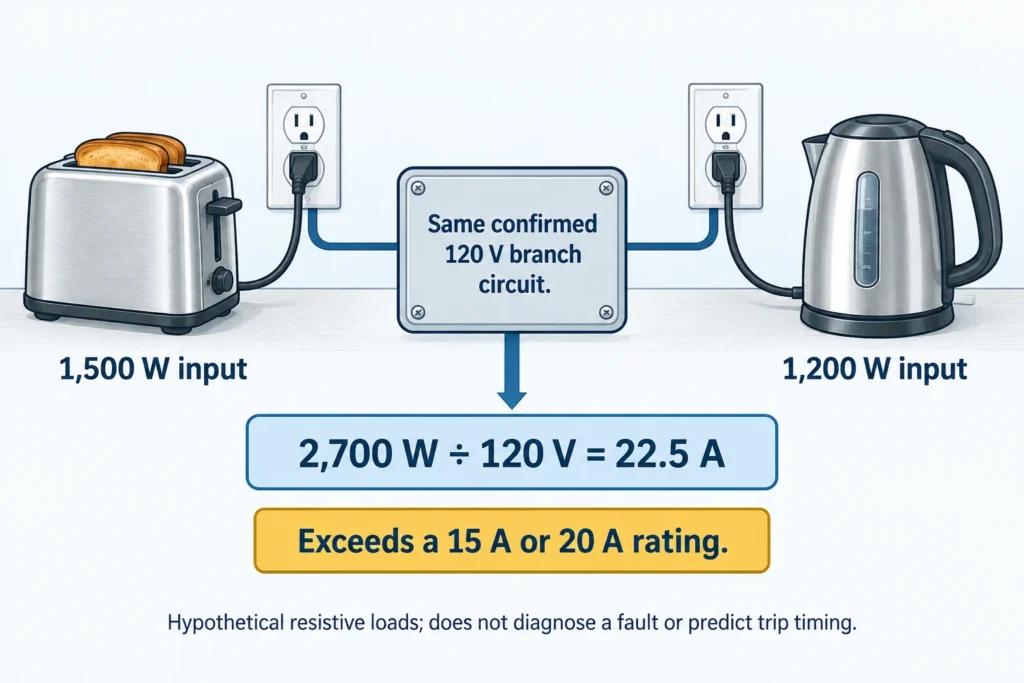
Here’s an example of shared capacity. In a hypothetical example, a 1,500-watt toaster and a 1,200-watt kettle use 2,700 watts while both heating elements operate. On a 120-volt circuit, 2,700 watts is equal to 22.5 amps. A breaker is rated either 15 amps or 20 amps. The calculation proves there is a real concern about an overload condition, and it's not simply the breaker being “weak.”[2][7]
I’d use that type of calculation to explain the demand, and not guess at the trip time. In the case of an appliance, use the electrical input watts or amps on a nameplate, not the output wattage. In the case of a motor or compressor, there is startup current that can be many times the running load.[3][7]
Timing helps narrow the question, not settle it
Was it right as an appliance started, or after everything had been running for a while? Your recollection helps. In a conventional thermal-magnetic breaker, sustained excess current heats the thermal mechanism, while sufficiently high current can trigger the magnetic mechanism quickly. But I wouldn’t turn that into “instant means bad appliance” or “delayed means overload.” Timing is a clue, not a verdict.[3]
| What you’ve already noticed | What it suggests | What it cannot prove |
|---|---|---|
| Trips only with a familiar combination | Shared demand is worth checking. | That either appliance, or the wiring, is fault-free. |
| Trips as an appliance starts | Startup current or a fault may be involved. | Which trip mechanism operated. |
| Trips after appliances have run for a while | Sustained overload or connection heating may be involved. | That reducing load is the only repair needed. |
| Has also tripped with one appliance operating | That appliance and its supply circuit need closer attention. | That the appliance is necessarily the failed component. |
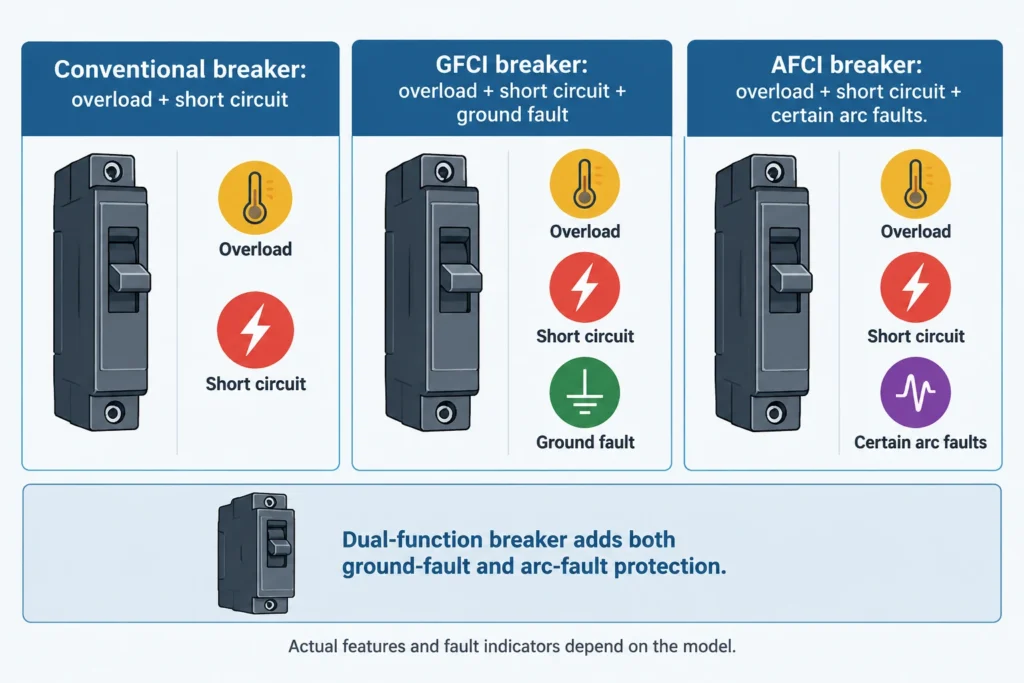
The breaker type matters, too. An AFCI adds protection against certain arcing conditions, a GFCI adds ground-fault protection, and a dual-function breaker adds both. They still protect against overloads and short circuits. So the same appliance combination can raise several diagnostic questions; the extra protection doesn’t mean every trip is an arc fault or ground fault.[4]
Record any fault indicators that are visible prior to any operation. Counting seconds between kettle-on and lights-out is not diagnostic sequencing. Those belong to the electrician. It’s best to treat those as other trips.[5]
Bring a short history, not another test
A service call doesn’t need a perfect circuit map. A few scribbles about circuit events are good and “I don’t remember” is better than a tidy guess. Here’s what’s worth writing down:
- What was operating on the circuit including heaters, coffee makers, and other equipment that automatically cycles on and off.
- Whether the interruption happened at startup or after some running time, using your best recollection.
- Which outlets, lights, or other equipment lost power during that event.
- Were there any single appliance trips, new equipment, recent electrical work, odd smells, sounds, or visible damage.
- What is the model number and input rating of the appliance, if available without moving the appliance.
- What is the handle rating of the breaker, and what does it say, if visible from the front and no warnings on the panel.
Ask for the finding before buying the fix
What would you ask the electrician? Ideally you would want to know what caused the trip and what did the electrician check before providing the recommendation. A recommendation for replacement doesn’t answer that. The assessment should cover the demand for the circuit (startup vs. running), the state of the equipment, connections and wiring, signs of overheating, other appliances, the breaker and it’s type and condition.[2][3][5]
For new/altered circuits, check if the recommendation accounts for permitted wiring capacity, breaker and panel capacity, and appliance installation requirements, including local codes. Similar looking parts aren't interchangeable. Schneider QO and Homeline breakers aren't interchangeable.[2][8]
Interrupting the circuit with a larger breaker isn't a repair. It creates a hazard by allowing unprotected use of the circuit and wiring. Using extension cords or power strips isn't a repair. The power strip adds no circuit capacity and the cord introduces loading, damage, and overheating issues. Removing AFCI and GFCI protection isn't a repair.[2][4][6]
If excess shared demand is confirmed and faults are ruled out, using appliances in a manner that doesn't create a demand greater than the circuit can support (e.g. not using too many appliances at the same time) may be all that's necessary. If you still need to use the appliances in an unsupportive manner, a properly designed additional circuit may be a good solution. A defect in an appliance, connection, or breaker needs to be repaired separately. Before agreeing to this repair, I'd want to know what the appliance use will be, why the repair is needed, and how it will be supported.[1][2][3]
Sources and references
- Electrical Safety Foundation International: Home Electrical Safety
- Consumer Product Safety Commission: CPSC Guide to Home Wiring Hazards
- Schneider Electric: How do you determine why a thermal-magnetic breaker nuisance trips? (2014-07-10)
- Schneider Electric: What is the difference between a GFI breaker, a CAFI breaker, and a DF breaker?
- Schneider Electric: QO, QOB, and HOM arc fault and dual function circuit breaker troubleshooting tips using time saver diagnostics (2008-10-13)
- Consumer Product Safety Commission: Household Extension Cords Can Cause Fires
- GE Appliances: Running an Appliance on a Generator
- Schneider Electric: Square D QO and QOB Miniature Circuit Breakers