
If you’re not trained in roof work, I’d call a roofer to address the shingles and contain the indoor drips to the extent that you can do so safely, e.g. at ground level. One missing shingle likely doesn’t require a full roof replacement. It may only warrant a small repair by a professional. Paying for a roof repair doesn’t mean that you have to agree to a full roof replacement.[2][3][4][6]
Ask the roofer about temporary protection if the permanent repair cannot occur in the near term. Temporary protection is not a long-term solution, and permanent repair may be needed to resolve the issue. GAF’s guidance states that if a tarp is being used as a temporary repair, the shingles where the tarp is affixed need to be permanently repaired, and sealant cannot be used for the long-term repair.[2][4]
The small job still has a roof-sized access problem
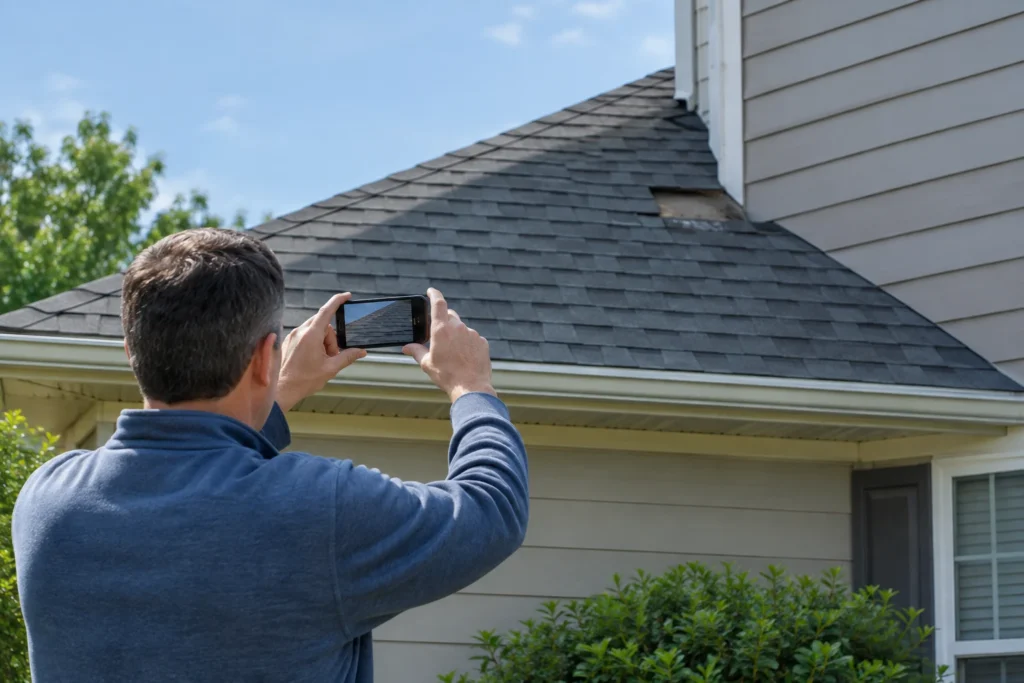
Picture me, in an example, noticing one bare shingle above a garage, and approximating the cost of a replacement shingle. Then I notice the path where the ladder would have to be placed, and look toward the shingle. The material doesn’t appear to be very expensive, but the job is another thing entirely. I am not planning to get the ladder, and instead take a picture to include with my request to the roofer.
The pitch of the roof affects how you are able to stand and work. Wind, rain, and frost can also make access tricky. The material has an effect as well; tile and slate can be easy to break, and asphalt can lose it's flexibility and seal over time. Even a low roof can have a strong deck that may not be able to hold your weight.[2][3][6]
You may see OSHA's six-foot rule mentioned in roofing advice. Its residential-construction guidance generally requires covered workers six feet or more above lower levels to have conventional fall protection or another permitted measure. That's a worker-and-employer requirement, not a height below which homeowner roof work becomes safe. I wouldn't use that number to decide whether you should climb.[1][2]
Give the roofer a useful view from the ground
Use binoculars or camera zoom from a stable ground-level position. Photograph the apparent missing, cracked, or lifted shingle, then widen the view to include nearby valleys, walls, chimneys, vents, and roof edges. Date the photos and note when you first noticed the change, recent storms, and any indoor staining. Those details are more useful than a close-up with no location.[3]
If you have access to an attic and can reach the decking safely, see if there is any water damage on the decking or rafters. Make sure you're not crossing potentially load-bearing framing. The ASHI standard also excludes walking across load-bearing components of the attic, so you shouldn't feel the need to do this as well.[3][7]
What the missing shingle can't tell you
A missing shingle is a good start, but it may not be the full story. What about the flashing around the roof intersections? What about the underlayment or decking? Your ground photos may point to the areas that need investigation, but they can not show the conditions of those hidden areas.[3][6][7][8]
I wouldn't wait for a full investigation just because there were some intact looking shingles. GAF describes its synthetic underlayment as 'secondary protection' and as 'temporary roofing.' A dry ceiling today may not mean a dry ceiling tomorrow. With no leaks at the moment, I would still call for an inspection.[3][8]
When it comes to the storm damage repair, GAF states that individual shingle repairs are permitted, however, the extent of surrounding damage may be impossible to assess. GAF also states that it is necessary to restore the fasteners and seals of neighboring shingles. Because of this, I am more concerned with how the roofers will leave the shingles in regards to the manufacturer's instructions, and not whether the shingles will be the correct color.[4]
Pay for a supported scope, not a guess
Proposals should let you see what you're buying and what will change when the roof is opened. I'd ask…[4][5][6]
- What photos and what findings support a spot repair vs. a repair of one roof plane vs. a broader replacement?
- What is included (shingles, flashing, underlayment, decking) and what is not (underlayment, decking, etc.)?
- How will neighboring shingles be restored, and what is the guidance of the shingle manufacturer?
- What will happen if more damage is found when the roof is opened? How will this be documented, and what will be the process to get my approval?
- What completion photos, and what terms and conditions of a workmanship warranty, will I receive? What will the exclusions and "callback" period be?
Be sure to request the roofer's current liability, auto, and worker's comp insurance policies and his applicable licenses. Don't assume a material warranty covers the roofer's workmanship. Ask what this coverage is for this repair.[5][6]
If the damage is isolated and the surrounding materials can be repaired, there's a good reason to keep the work minor. Failed underlying materials or fragile neighboring shingles can change this. A leak alone doesn't mean whole-roof failure. If you're offered a replacement, I would ask for an explanation and photos to support the need for a bigger repair.[4][5][6]
Sources and references
- Occupational Safety and Health Administration: Fall Protection in Residential Construction
- Occupational Safety and Health Administration: Reducing Falls During Residential Construction: Roof Repair (2011-09)
- CertainTeed: What type of maintenance does my roof require?
- GAF Technical Services: TAB-R-126: Replacement Of Storm Damaged Shingles
- National Roofing Contractors Association: Selecting a Contractor
- National Roofing Contractors Association: Roofing Guidelines: Resources
- American Society of Home Inspectors: Standard of Practice
- GAF Technical Services: Ensuring Maximum Protection When Installing Synthetic Roof Deck Protection (2020-08-05)