
The attic is often where expensive house problems show up first, in the form of clues. A short inspection can reveal a small roof leak, a disconnected bathroom fan, or thin insulation at the eaves long before you are paying for drywall repair, sheathing replacement, or higher heating and cooling bills. EPA guidance lists leaking roofs and high humidity among common moisture problems that can lead to mold, while DOE and ENERGY STAR emphasize that air sealing, insulation, and ventilation work together in the attic. (epa.gov)
TL;DR
- Use the attic as a diagnostic zone, not a guessing game. Look for water entry, moisture movement, and missing thermal coverage in one pass.
- Any active moisture, wet insulation, a disconnected exhaust duct, widespread mold, or vermiculite insulation moves the job out of casual DIY territory. (epa.gov)
- Fix water leaks and air leaks before paying to add insulation. (energystar.gov)
- If the attic clues are incomplete, a professional energy assessment with blower door or thermographic testing can reveal what a visual check may miss. (energy.gov)
Start with the RISE attic score
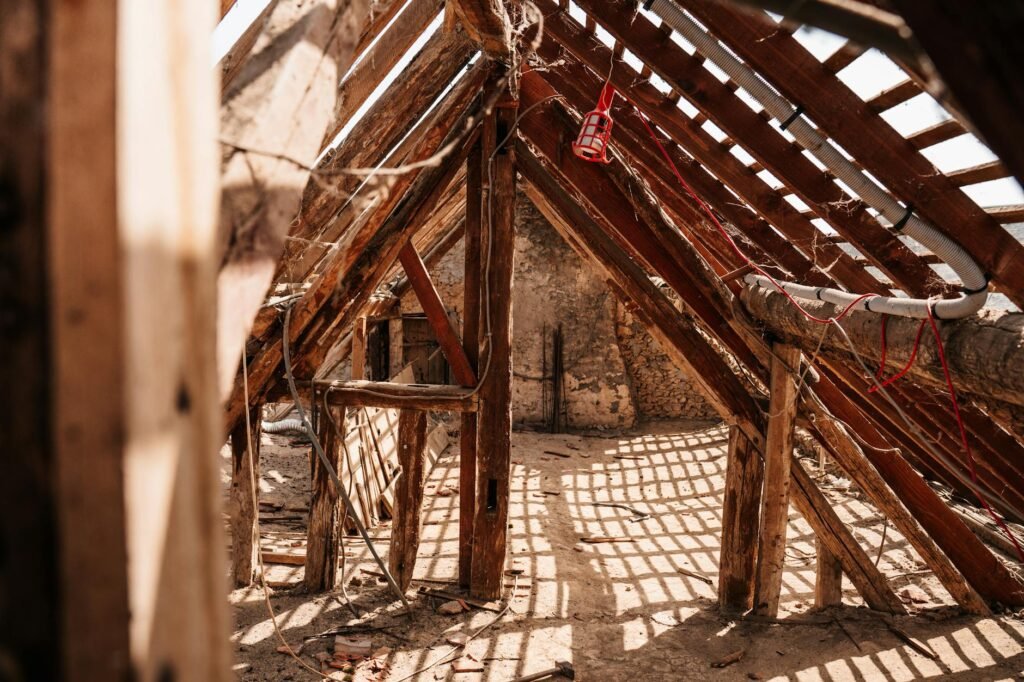
Before you plan repairs, sort what you see with one simple framework: the RISE Attic Score. R is for roof evidence, I is for insulation coverage, S is for steam and air leaks, and E is for edge conditions at the eaves and soffits. Score each category from 0 to 3: 0 means no visible issue, 1 means isolated or minor, 2 means repeated or clearly underperforming, and 3 means active failure or obvious moisture damage. This is an original scoring tool, but it is built around common attic warning signs described in EPA, DOE, ENERGY STAR, and inspection guidance. (epa.gov)
| Category | What to check | What a 3-point finding looks like |
|---|---|---|
| Roof evidence | Stains, damp sheathing, rusty fasteners, daylight around penetrations | Active drip, wet decking, or a growing stain tied to a roof area |
| Insulation coverage | Thin spots, missing sections, compressed batts, wet or matted fill | Large bare areas, soaked insulation, or major gaps at the hatch or eaves |
| Steam and air leaks | Bath fan or dryer vent issues, hatch leakage, pipe and wire penetrations, condensation or frost | Moist air is clearly reaching the attic and leaving condensation, frost, or mold clues |
| Edge conditions | Blocked soffits, missing baffles, wind-washed eaves, perimeter gaps | Soffit airflow is blocked and insulation is failing right where attic heat loss is often worst |
A total score of 0 to 2 usually means monitor and recheck seasonally. A 3 to 5 means schedule repairs soon. A 6 or higher means it is time to stop treating the attic as a weekend chore and start treating it as a priority repair project. Any single red-flag issue, such as active water, widespread mold, sagging materials, or vermiculite, overrides the score and justifies a professional call. (epa.gov)

The attic inspection checklist that is actually worth doing
- Pick a useful inspection time. Daylight helps, and if you are chasing a suspected leak, inspect soon after a hard rain. If the weather has been dry for weeks, treat dry stains as clues, not proof that the leak is gone. (nachi.org)
- Bring a bright flashlight, your phone, a tape measure or ruler, and a notepad. If you already own one, a humidity meter can also be useful because EPA says indoor relative humidity should stay below 60 percent, ideally 30 to 50 percent. (epa.gov)
- Start at the hatch. Check for weatherstripping, an insulated cover, and dark dust lines that can suggest air leakage. DOE says attic access should be insulated and air sealed. (energy.gov)
- Scan the underside of the roof deck and framing. Look for stains, a wet sheen, rusty nail tips, black spotting, soft wood, or daylight around penetrations. Attic-side evidence often shows up near vent stacks, skylights, valleys, and other roof penetrations. (nachi.org)
- Trace every ceiling penetration. Pipe holes, wiring gaps, recessed lights, chimney chases, and loose attic hatches can let warm, moist indoor air reach a cold attic and condense there. (epa.gov)
- Measure insulation in more than one place. Check the center of the attic, the perimeter, and the hatch area. DOE notes that thickness alone does not fully determine loose-fill R-value, but shallow, missing, wet, or compressed spots still deserve attention. (energy.gov)
- Look closely at the eaves. ENERGY STAR warns against covering soffit vents with insulation; baffles or rafter vents should keep an airflow path open. (energystar.gov)
- Confirm where exhaust goes. Bathroom fans and clothes dryers should vent to the outside, not into the attic, because that moisture can feed condensation and mold. (epa.gov)
- If you see vermiculite insulation, stop disturbing the area. EPA advises homeowners to assume vermiculite attic insulation may contain asbestos and to leave it undisturbed until an accredited professional advises next steps. (epa.gov)
- Take photos from the same angles and sketch where each issue sits. That makes contractor bids easier to compare and gives you a baseline for rechecks.
Informational only: If you find mold over about 10 square feet, heavy water damage, or suspect vermiculite, do not treat the job like ordinary cleanup. EPA says larger mold problems and vermiculite insulation call for more caution and, often, professional help. (epa.gov)
What the clues usually mean
| What you see | What it often points to | Best next move | Money priority |
|---|---|---|---|
| Stain around a plumbing vent or small roof penetration | Localized flashing or vent-boot problem | Photograph it, recheck after the next rain, and get a roofer to inspect that specific penetration | High. Localized leak repairs are usually cheaper than deck and ceiling repair later. (nachi.org) |
| Rusty nail tips, winter frost, or widespread dark spotting | Moist indoor air reaching a cold attic | Seal attic bypasses, fix exhaust ducting, and keep soffit airflow open | High. This is a moisture-path problem, not just a cosmetic stain problem. (epa.gov) |
| Insulation thin at eaves or missing around the hatch | Heat loss, comfort complaints, and possible condensation risk | Air seal first, then add insulation to proper levels for your climate | Medium to high. Insulation alone will underperform if leakage is left in place. (energystar.gov) |
| Wet or matted insulation below one roof plane | Active or recent water entry | Fix the leak source first, then replace damaged insulation after materials are dry and clean | High. Adding new insulation before fixing the leak wastes money. (epa.gov) |
| Bathroom fan or dryer duct ending in the attic | Condensation and mold risk from indoor moisture | Re-route it and vent it outdoors | Very high. The fix is often modest; the downstream damage is not. (epa.gov) |
| Vermiculite insulation | Possible asbestos-containing material | Leave it alone and call an asbestos professional before any insulation or wiring work | Immediate stop sign. (epa.gov) |
A realistic household example with numbers
Here’s another example: a house of 1,850 square feet. One upstairs bath. Vented attic. On inspection in March the owner finds stain near one plumbing vent, rusty nail tips over the north roof plane, and insulation about 11 inches thick in the center of the attic, but only 4 to 5 inches thick near several eaves. The bath fan duct is loose and dumping into the attic. The attic scores a 7 on the RISE scale; this is no longer a monitor-only situation.
A sensible spending order might look like this: about $300 to $500 for a localized roof repair, about $150 to $300 to reconnect and properly vent the bath duct, and about $1,200 to $2,000 for air sealing and topping up insulation, depending on the market and attic size. That is still serious money, but it is targeted money. Ignore the same attic for another season and you may end up paying for stained ceilings, insulation removal, sheathing work, mold cleanup, and the original fixes anyway. The potential savings come from sequencing the work correctly: stop water, stop moist air, then pay for thermal improvement.

The mistakes that quietly make the bill worse
- Adding insulation before fixing water leaks or air leaks. DOE and ENERGY STAR both put air sealing ahead of new attic insulation for a reason. (energystar.gov)
- Judging the whole attic by the deepest pile of blown insulation. Measure multiple locations, especially the perimeter and hatch area. DOE notes that thickness alone is not enough to determine loose-fill insulation performance. (energy.gov)
- Blocking soffit vents with insulation. ENERGY STAR specifically warns against covering soffit vents; use baffles to preserve airflow. (energystar.gov)
- Buying a mold test kit before fixing the moisture source. EPA says visible mold usually does not require sampling to tell you that cleanup and moisture control are needed. (epa.gov)
- Disturbing vermiculite or painting over moldy material. EPA advises leaving vermiculite undisturbed and fixing the water problem, not just covering the symptom. (epa.gov)
When the attic will not tell the whole story
Attic evidence has limits. A stain can be dry during a long dry spell even if the roof defect still exists. Water can also travel before it shows itself, so the visible clue is not always directly under the failed roof detail. And if your attic is already reasonably sealed and insulated but rooms still feel drafty or run hot and cold, DOE says the next place to investigate may be exterior walls or other parts of the building envelope. (nachi.org)
- If the leak path is unclear, ask for a targeted roof inspection tied to the stain location, not just a broad replacement quote.
- If comfort and moisture issues persist, schedule a professional home energy assessment. DOE says these often include blower door testing and thermographic scans, and utilities may offer them at low or no cost. (energy.gov)
- If mold is extensive or the water damage is heavy, hire a contractor with real mold-remediation experience. EPA suggests professional help once the affected area is larger or the damage is substantial. (epa.gov)
- If vermiculite is present, bring in an accredited asbestos professional before anyone moves insulation or opens new chases. (epa.gov)
How to pressure-test the fix
- Save before photos and note the date, weather, and exact locations you checked.
- Reinspect the same spots after the next hard rain or major temperature swing. The minimum standard is no new staining, dripping, frost, or damp insulation.
- Track indoor humidity for at least a couple of weeks. EPA says keeping relative humidity below 60 percent, ideally 30 to 50 percent, helps reduce mold risk. (epa.gov)
- Confirm that the fix did not create a new problem: soffits remain open, the fan duct reaches outdoors, the hatch still seals tightly, and insulation coverage is still even. (energystar.gov)
- If the house still feels wrong, move beyond visual inspection and book a professional assessment with blower door or thermographic testing. (energy.gov)
Bottom line
The attic inspection that saves money is not the one that notices every odd stain. It is the one that separates water problems, moist-air problems, and insulation problems in the right order. Use the RISE score, document what you see, and spend first on causes, not cosmetics. If the attic points to mold, asbestos risk, or a hidden leak path, paying the right specialist once is often cheaper than paying the wrong contractor twice. (epa.gov)
Frequently Asked Questions
How often should I inspect my attic?
A practical schedule for attic checks is two times per year, typically in the spring and fall of each calendar year; again after wind events, ceiling stains, ice dams, or musty odors. The objective of attic checks is to identify changes at the first sign of change versus checking the attic on a monthly basis.
Can I just add more insulation where the attic looks thin?
Usually only after you fix roof leaks and air leaks. DOE and ENERGY STAR both emphasize air sealing before adding attic insulation, and ENERGY STAR recommends comparing current insulation to climate-based targets instead of guessing by sight alone. (energystar.gov)
What if I see black spotting on roof sheathing?
Treat it as a moisture clue first. EPA guidance is to control the moisture source, then clean or replace affected material as needed. If the area is extensive or there has been significant water damage, bring in a professional. (epa.gov)
Do I need a mold test kit before calling anyone?
Usually no. EPA says visible mold typically does not need sampling, because the action item is the same either way: clean it up and fix the water source. Testing is more useful in narrower situations, such as post-remediation verification or complex hidden-mold investigations. (epa.gov)
Will an attic fan solve attic condensation?
Not by itself. ENERGY STAR notes that if the attic is not well sealed from the house or soffit vents are blocked, an attic fan can pull conditioned air into the attic and waste energy. Start with air sealing, correct exhaust ducting, and clear ventilation paths. (energystar.gov)
What if I find vermiculite insulation?
Stop the inspection there. EPA advises homeowners to assume vermiculite attic insulation may contain asbestos and to leave it undisturbed until an accredited professional advises next steps. (epa.gov)
References
- US EPA: Mold Cleanup in Your Home – https://www.epa.gov/mold/mold-cleanup-your-home
- US EPA: Mold Course Chapter 2 – https://www.epa.gov/mold/mold-course-chapter-2
- US EPA: Is Sampling/Testing for Mold Necessary? – https://www.epa.gov/mold/samplingtesting-mold-necessary
- US EPA: My attic has vermiculite insulation in it. Am I at risk? Should I take it out? – https://www.epa.gov/asbestos/my-attic-has-vermiculite-insulation-it-am-i-risk-should-i-take-it-out
- Department of Energy: Where to Insulate in a Home – https://www.energy.gov/energysaver/articles/where-insulate-home
- Department of Energy: Adding Insulation to an Existing Home – https://www.energy.gov/energysaver/adding-insulation-existing-home
- Department of Energy: Detecting Air Leaks – https://www.energy.gov/energysaver/detecting-air-leaks
- Department of Energy: Professional Home Energy Assessments – https://www.energy.gov/energysaver/professional-home-energy-assessments
- ENERGY STAR: About Attic Ventilation – https://www.energystar.gov/saveathome/seal_insulate/do-it-yourself-guide/about-attic-ventilation
- ENERGY STAR: Recommended Home Insulation R-Values – https://www.energystar.gov/saveathome/seal_insulate/identify-problems-you-want-fix/diy-checks-inspections/insulation-r-values
- InterNACHI: What Your Attic Reveals: The Truth About Your Roof’s Hidden Health – https://www.nachi.org/attic-roof-inspection.htm