
Your refrigerator may be leaking household supply water, overflowing defrost meltwater, or shedding condensation or dispenser runoff. Those paths need different responses. First protect yourself from electrical exposure and contain the accessible water; then look for where fresh water appears. I wouldn’t buy a drain kit, or condemn the refrigerator, based on the puddle alone.
For a small puddle clearly away from electrical connections, blot up water you can reach from dry flooring. Keep towels outside the appliance, not stuffed underneath it where they might obstruct airflow. Photograph the wet area and check nearby cabinet edges and floor seams for moisture. Don’t pull the refrigerator out alone to chase the source.
Where the water appears is only half the story
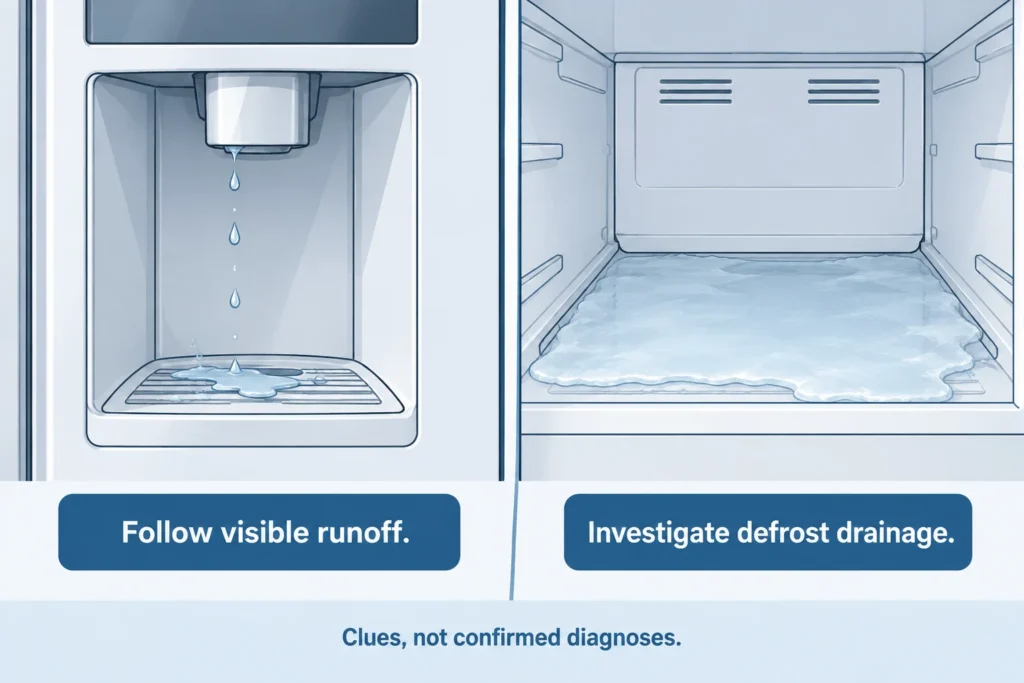
Water can travel before you see it, so a front puddle doesn't prove a front-mounted part failed. Timing helps, but there's a catch: the ice maker fills automatically. Nobody needs to press the dispenser paddle for household water to enter the refrigerator.
Imagine I'm finding a damp sock beside the refrigerator before breakfast, with yesterday's towel still waiting to be washed. I'm annoyed enough to order the first replacement part a search recommends. Instead, I photograph the wet area and note the overnight timing. That gives me something useful to investigate, rather than another part bought on a guess.
| What you notice | What it may suggest | Useful next response |
|---|---|---|
| Ice or water on the freezer floor, with recurring water in front | Defrost water may not be reaching its drain pan | Photograph the ice; arrange model-specific drain assessment if access is concealed |
| Fresh water near an already-visible supply tube or connection | A household-water leak | Close the identified refrigerator supply valve if it is safely accessible |
| Water appears around an accessible filter, especially after replacement | Filter seating, cartridge, or housing trouble | Observe the wet area and compare the cartridge and lock with your model's instructions; isolate incoming water before manipulating a leaking assembly |
| Drops stay in the dispenser recess after use | Dispenser runoff or trapped air after filter work | Dry the removable tray if applicable; investigate persistent dripping |
| Beads form on exterior surfaces and run downward | Condensation rather than a concealed plumbing leak | Check door closure, visible seals, and any model-specific anti-sweat control |
When incoming water needs to be stopped
If the water supply line is wet or there is a leak originating from the filter, then shut off the water supply valve from a dry location. The valve could be located in a basement or near the sink. Don’t force a stuck valve or move the fridge. If there is a leak with no shutoff valve, then contact a plumber or take other measures to prevent further damage.
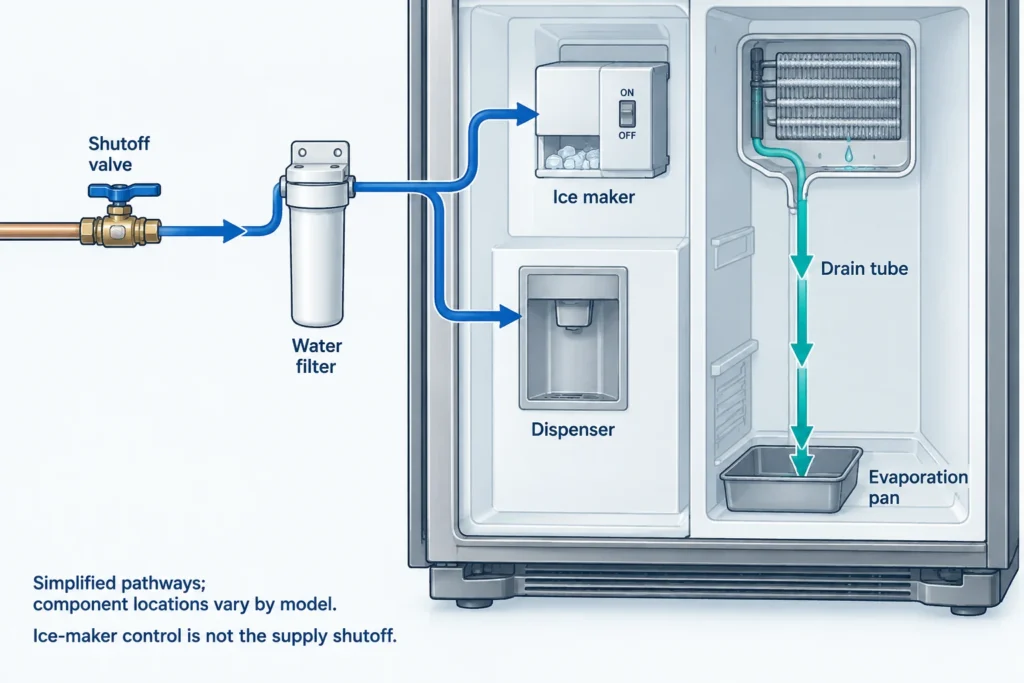
Turning off the ice maker will not help, you have to shut off the water supply line as well. Once the supply line is shut off, you need to use the ice maker switch to turn off the ice maker and stop using the dispenser.
If there is a leak in the supply line, rather than assuming that and buying a new inlet valve, there are other things to check first. The supply line to the dispenser or the ice maker fill line could be leaking. Another possibility could be the filter. This is troubleshooting logic rather than a hard rule.
Freezer-floor ice points toward drainage, not a universal fix
According to GE, water accumulated in the evaporator during automatic defrost evaporates once it reaches the drain in the bottom of the refrigerator case. In the case of a clog, water can freeze to the floor of the freezer case or escape to the kitchen floor. Therefore, puddles can occur on the kitchen floor, even if the refrigerator case has no household water connection.
The snag with generic advice to clean a drain is access. For the configurations of GE refrigerators that describe automatic defrost, the drain is inaccessible because it is fixed, and the pan does not require maintenance. Some side-by-side configurations provide owner procedures while others require service. I would not use the mixed guidance to boil a water or use a wire or ice to unclog your refrigerator.
If accessing the drain requires removing the case or moving the appliance, stop there. Ice on the freezer floor and visible drain are not an invitation to flush the drain. An owner procedure must be provided for your specific model.
Check the filter and visible runoff before blaming hidden parts
Was this occurring before a filter change? Is there water around the cartridge? Is the part number on the cartridge the same as the part number for the filter you changed? Is the cartridge fully seated? Is the cartridge bent or deformed? Is there water on the case? For these questions, the best first step is to take a close look. Don't mess with the filter if water is still on the case and leave the case with a broken or deformed housing.
I have concerns about the “just remove the filter” advice, because designs can vary. Samsung mentions removal as part of its troubleshooting, but the Whirlpool manual W11511883 Rev. D describes a base grille eject-button filter with O-rings and a locking clip. Removing that design’s cartridge requires the specification of the filter-cap assembly. That manual describes a design, not an instruction, for your refrigerator. Identify the cartridge, as well as any required bypass components, before operation without a filter.
Not every dispenser drop means a failed part. GE says a couple drops after dispensing can be normal, and that applicable, removable trays can be left out to dry. Samsung mentions trapped air after filter changes as a potential cause of drips. Still, drips can’t explain recurring cabinet-floor water over a long period of time, unless you can follow the path of the water. I’d like to see that connection before discarding the puddle.
If you see beads of moisture on the exterior of the refrigerator, check if a food package is holding the door open, check for dirt and tears, and check the gasket for gaps. On applicable GE models, the Energy Saver setting, which sounds backwards, turns the anti-sweat heaters off. Turning the Energy Saver off can help with moisture on those surfaces. It won’t repair a supply leak.
Ask what failed, then watch ordinary use
More info from you can help us help you. Tell us your model number. Where did you first see fresh water? When does it return? Has the filter been worked on recently? Were the supplies closed? Household shut off valves and tubing are plumbing problems. Fill lines and drains are appliance problems. I would ask “Which water path has failed? And how will you check it after the repair?”
Fix the cause of the problem and make sure normal operation resumes. Dry off any wet surfaces. Check for fresh water after normal dispensing and after the auto ice making cycle and in the morning. Don't reopen an unresolved supply shut-off to test it.
A closed supply still means containment worked. I would say the repair was finished after normal operation brought the water back and after numerous tests, not after a single test.
Sources and references
- CDC: What to Do to Protect Yourself From Electrical Hazards (2024-05-15)
- U.S. Consumer Product Safety Commission: Home Electrical Safety Checklist
- GE Appliances: Refrigerator, Water on Floor
- GE Appliances: Refrigerator & Freezer, Drain Tubes
- Samsung: Water leaks in a Samsung refrigerator
- GE Appliances: Refrigerator, Dripping or Leaking Water from Dispenser
- Whirlpool: Leaking at the Bottom, Bottom Freezer Refrigerator
- GE Appliances: Refrigerator, Moisture on the Exterior
- Whirlpool: Whirlpool refrigerator owner manual W11511883 Rev. D
- Whirlpool: How to fix a refrigerator that is leaking water
- GE Appliances: Bottom Freezer Refrigerator, Clogged Drain Tube, Ice on Freezer Floor
- GE Appliances: Side-by-Side Refrigerator, Water on Floor, Repairing a Clogged Defrost Drain