
One clue that rainwater may be the cause of a ceiling stain is whether or not the stain changes after it rains. If the stain does change, one possibility is that during dry weather, the rain cut-off the flow to the stain, but did not close the opening to the leak. While this may provide some helpful evidence to track the leak, it doesn't necessarily locate the leak, rule out plumbing leaks, or condensation. In this case, I would take the recurring change of the ceiling stain seriously, but wouldn't necessarily assume the roof directly above the stain needs repair.[1][2]
The mark is where water showed up
Water can follow a sloping concealed surface or framing member before dripping onto your ceiling, rather than falling straight through the roof opening. Materials may absorb some of it along the way, so the mark can appear away from the entry point, and later than the actual wetting. The stain tells you where water became visible, not necessarily where it got in.[1][2]
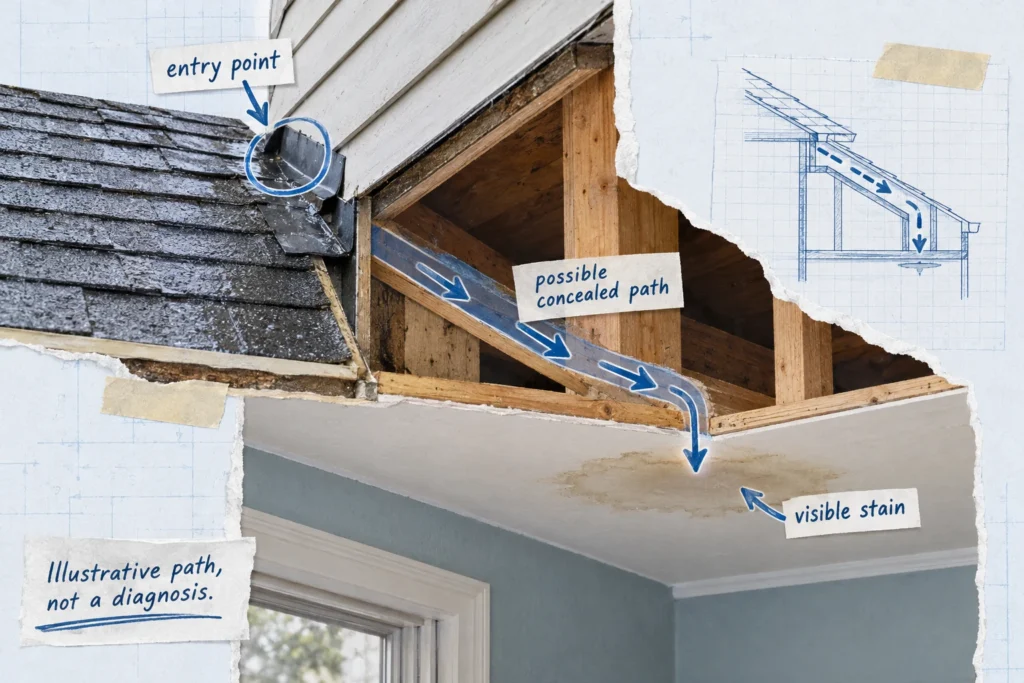
Picture me in an imagined example, shifting a chair away from a brown ceiling ring and trying to line it up with the roof outside. The upstairs wall blocks my view and the line of sight repair becomes more of a guess. I know the roofer has a lot on his/her plate, but a picture says a thousand words so I send some pictures of the room and the dates the stain changed to help give some context.
Inconsistent weather can help explain why that guess can go wrong. Valleys in a roof and flashing can also help focus water flow and direct it away from joints and penetrations. Storms can be very helpful in identifying the source of a leak, but storms in and of themselves can not be the basis for replacement of an entire roof.[1][4]
Which timing clues change the investigation?
| What you notice | What it points toward |
|---|---|
| Worsening after rain, especially with particular winds or prolonged rainfall | Rain entry through the roof or adjoining exterior details; record which storms reproduce it. |
| Fresh wetting during dry weather after an upstairs shower or other fixture use | A supply, drain, or fixture-related leak deserves investigation. |
| Changes alongside high indoor humidity, cold weather, or cooling-system operation | Condensation or HVAC-related moisture deserves consideration; condensation requires a sufficiently cold surface. |
I wouldn’t try to recreate a damaging leak by running fixtures. There are a lot of things to be mindful of and capture. It’s not always the case that there’s a long delay after it rains.
Give the roofer more than a brown circle
Contact a roofer as soon as you start noticing repeating rain-related changes and don’t attempt to collect a lot of data yourself. You’re already in a safe position on the floor. A picture says a thousand words. They don’t need to go into the attic or climb on the roof to capture the information I’m about to tell you.[5]
- They need to take a picture and label it with the date and time and include a description of the change.
- Be mindful of fixture locations. Sketch the position of the stain in relation to walls and determine the location of the stain in relation to upstairs rooms.
- Record the start and stop times of rain, approximately how long it rained, how intense it was, the direction of the wind if you noticed any, and when it started to get dark or when it started to rain.
- Mark whether it rained or dripped after the last storm, if any HVAC or fixtures were on during the storm, and if any recent storms didn't produce any visible results. Leave anything you don't know a blank.
A dry ceiling isn’t the same as a corrected leak
It’s good to see the ceiling dry, but I wouldn’t take that to mean it’s ready to be painted. Hidden cavities can remain moist while the surface looks dry. The EPA says to dry out clean water-damaged materials within 24 to 48 hours, but that doesn't mean you have 24 to 48 hours to wait before mold starts to grow. Water can travel through roofing materials, and it’s not always ‘clean’ water. Wet or swollen materials need to be removed or dried.[3][9]
While we look for the entry path, we need to address any moist or wet materials that may have been affected by water.
Before any work is done, I’d like to know, “what did you find that connects this repair to my stain, and how will you test it later?” A dry day may show a defect, but how does it hold up in rain? A light shower offers little reassurance about wind driven rain. Fix the source of the water and the affected materials first, then repaint.[5][9]
Sources and references
- Building Science Corporation: BSD-013: Rain Control in Buildings (2011-08-22)
- U.S. Environmental Protection Agency: Moisture Control Guidance for Building Design, Construction and Maintenance (2013-12)
- U.S. Environmental Protection Agency: Table 1: Water Damage, Cleanup and Mold Prevention
- GAF: TAB-R-121: Proper Flashing
- National Roofing Contractors Association: Roofing guidelines: Inspection and Maintenance, printed page 49
- American Red Cross: Disaster Cleanup & Repair For Your Home
- National Weather Service: Safety After the Storm
- Federal Emergency Management Agency: IS-1104: Photographing Damage
- U.S. Environmental Protection Agency: Mold Course Chapter 4