
When ice forms on your A/C unit, active cooling stops. For a central A/C unit, move the thermostat to the OFF position. Trane instructs doing this to defrost the evaporator and warns that continued operation with a frozen evaporator can cause damage to the unit. For a room unit, discontinue cooling and look for the unit-specific instructions for thawing. Repeatedly restarting a unit will not cool the house any faster. Ice on your A/C unit is a sign that heat transfer is not working properly and does not mean that your A/C unit is cooling the way that it should.
There are two tasks involved here: letting the unit thaw and figuring out why the unit froze. A frozen A/C unit can be caused by a clogged air filter. Other causes may include faults that are not noticeable from the outside. The disappearance of ice from the A/C unit completes the first part of the process.
Let it thaw without improvising
“Turn the fan on” is not always the case. For some units, this is the recommended method for thawing, but for others, it can cause more harm than good. GE warns that using the fan on a room unit can blow meltwater into the house. Older GE unit manuals give different freeze-up settings for different control types.
Look for the thawing instruction manual for your unit. These manuals may also tell you the settings for the unit and give thawing delay times. Until you find this information, keep the unit in the OFF position. For the thawing process, do not use a sharp object to break the ice, do not use heat, do not remove the cover of the unit, and do not alter the controls of the unit. Leave the controls of the unit set to the OFF position.
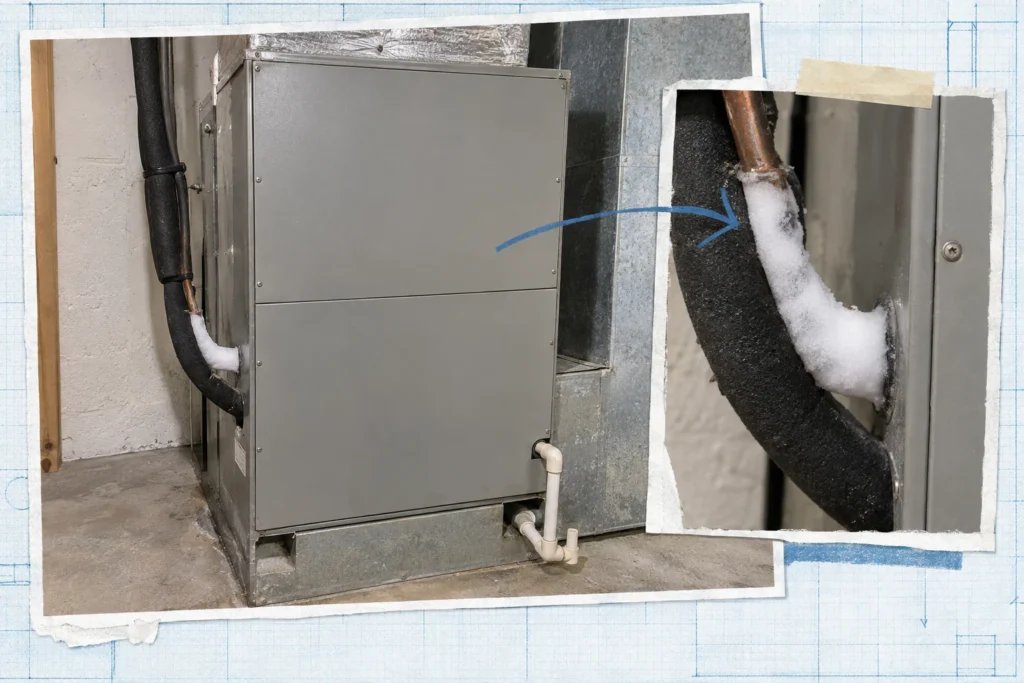
Different faults can leave you with the same ice
The evaporator coil absorbs heat from air passing over it. Moisture in the air condenses on the coil. If the coil gets cold enough, moisture in the air will turn to frost. A clogged filter can slow the flow of warm air across the coil. Other problems, like a dirty coil or an obstructed blower, can do the same. The ice itself obstructs the coil and can make the problem harder to identify.
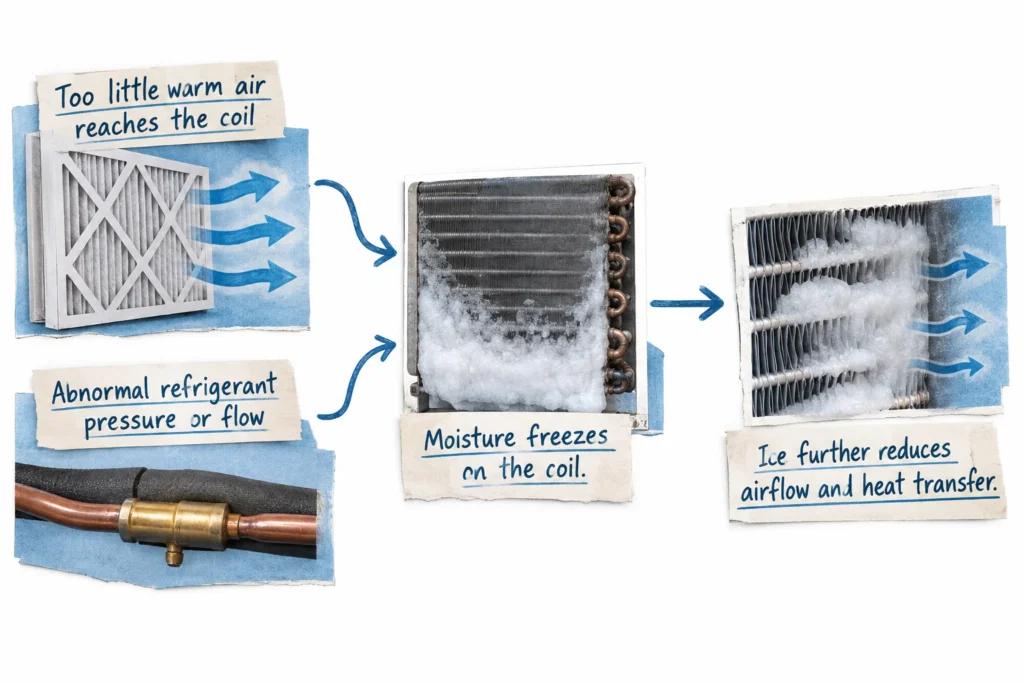
The same problems can cause abnormally low temperatures in the refrigeration system. A low refrigerant charge can be from a leak or an improper charge from previous service. A restriction in the flow of the refrigerant can also make the system act as if it is low on charge. I would want to see evidence or measurements for the statement “it needs refrigerant.” An icy pipe or compressor tells you there is a problem, not what the repair should be.
Imagine I’m standing in a warm hallway, holding a replacement filter while dinner waits on the counter. The old filter sits there… dreadful. I want to call the case solved. I'd love that cheap answer. But I would change the filter and keep cooling off until the thawing and restart conditions are met, rather than turn a valuable clue into an all-clear.
What you can learn without opening the equipment
- Cooling off: Check the filter in its designated homeowner-access location. Replace a dirty disposable filter with the specified size and compatible type. A more restrictive filter is not an upgrade if the system can’t accommodate it.
- Move furniture or personal belongings blocking return grilles or supply registers and note which registers are blocked.
- For ice, note whether airflow decreased and exactly where you found the ice. Mention any recent filter changes or other service-related work.
- For room units, check if the outdoor conditions and fan setting fall within that model’s restrictions for permitting cooling. There’s not a single outdoor temperature cutoff for all AC units.
Findings a dirty filter is better than finding a clean filter. A clean filter doesn’t tell you if the blower is moving enough air through the system, if the coil is dirty, or if the ductwork is restricting the airflow.
same situation applies after thawing. Stronger airflow may simply mean the obstructing ice has been removed.
When another cooling run is reasonable
A monitored restart may be justified if the likely cause has been corrected, all equipment has thawed, meltwater has been managed, and there is no electrical exposure, and your model permits cooling in your climate. Follow the manufacturer’s directions for restart and delay. My recommendation is based on many years of heating and cooling industry experience. I wouldn’t restart the equipment to hunt for the cause without a reasonable fix.
It can be awkward when a pipe clears while a coil still has ice. A pipe clearing or a waiting a fixed time does not prove complete thawing. You don’t need to open the case to check. If your model’s thawing instructions do not tell how to determine readiness to thaw, keep the equipment off and contact your service provider. If you get a permitted restart, return of ice, continued poor airflow, or continued poor cooling, do not cool and contact your service provider. Continued thaw and retry cycles are not a valid repair.
One scope distinction: outdoor frost on a heat pump while it’s heating can be normal if automatic defrost clears it. That doesn’t explain indoor evaporator icing during cooling, or excuse persistent ice that fails to clear.
A repair should come with an explanation
You don’t need to speak in refrigerant pressures to ask a useful question: “What made the coil freeze, and what did you find that supports that?” For an airflow diagnosis, ask about blower operation, coil condition, and restrictions through the filter and ducts. If low charge is suspected, ask how it was distinguished from a refrigerant-flow restriction and whether leakage or an earlier charging error explains it. DOE guidance and newer Lennox service literature support checking both airflow and refrigeration conditions. I’d want that explanation before treating a refrigerant addition as the whole answer.
When handling refrigerant, it should be left to a technician with the appropriate EPA Section 608 certification. The certification is specific to the service of specified refrigerants, and is not the same as a state Contractor’s license.
Before the job is called finished, ask for operation under conditions that permit meaningful model-specific checks, with airflow and refrigerant findings explained. A brief blast of cold air isn’t enough. You want sustained cooling without renewed icing, deteriorating airflow, or abnormal water escape. If weather prevents a meaningful test, ask what follow-up is needed. I’d rather have that unfinished item stated plainly than hear “all fixed” because the ice melted.
Sources and references
- Trane: Help! My AC Evaporator Coil Is Frozen
- GE Appliances: GE Room Air Conditioners Owner's Manual, 49-7405-3 (2000-12)
- GE Appliances: Air Conditioner, Ice On Indoor Coils
- U.S. Department of Energy, Building America: Measure Guideline: Air Conditioner Diagnostics, Maintenance, and Replacement (2013-03)
- Lennox: EL16KC1 R-454B Series Service Literature, Corp. 100121 (2025-01-10)
- U.S. Environmental Protection Agency: Section 608 Technician Certification
- Electrical Safety Foundation International: Electrical Safety during Natural Disasters
- Trane: What Is a Heat Pump Defrost Cycle? (2026-02-19)