
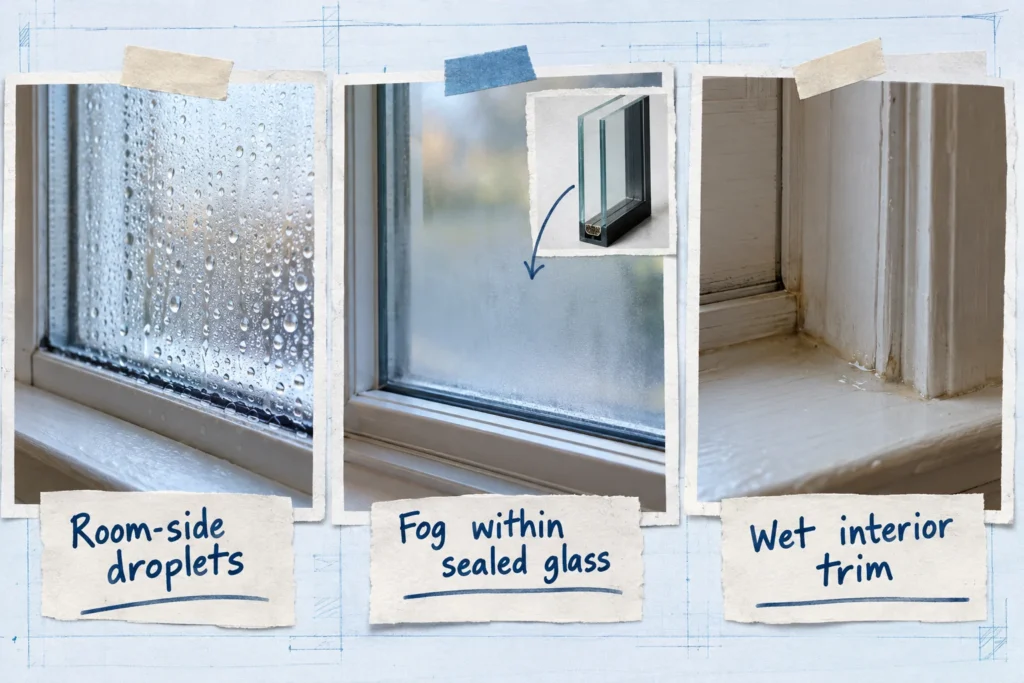
If your windows sweat on the room-facing glass during cold weather, condensation is usually the explanation: indoor moisture collecting on a cold surface. Fog trapped within sealed double-pane glass points toward a failing glass seal, while fresh water around the opening during rain or thawing warrants a leak investigation. I’d start by locating the wet surface. “Inside the window” sounds specific until you’re trying to decide which part needs attention.[2][4][7]
While you sort that out, wipe up droplets and standing water, and move curtains or belongings away from wet finishes. EPA recommends drying wetted materials within 24-48 hours to reduce the likelihood of mold growth. That’s a reason to start now, not permission to leave a damp sill until tomorrow.[1]
First, find the surface that’s actually wet
Wipe a small patch of room-side glass with a dry cloth. If the droplets disappear there, you’ve located surface moisture. If fog remains, it may be on the exterior face or within the glass assembly; a photograph alone rarely settles that distinction. Check an exterior face only where you can reach it safely without climbing or leaning out.[2][3][4]
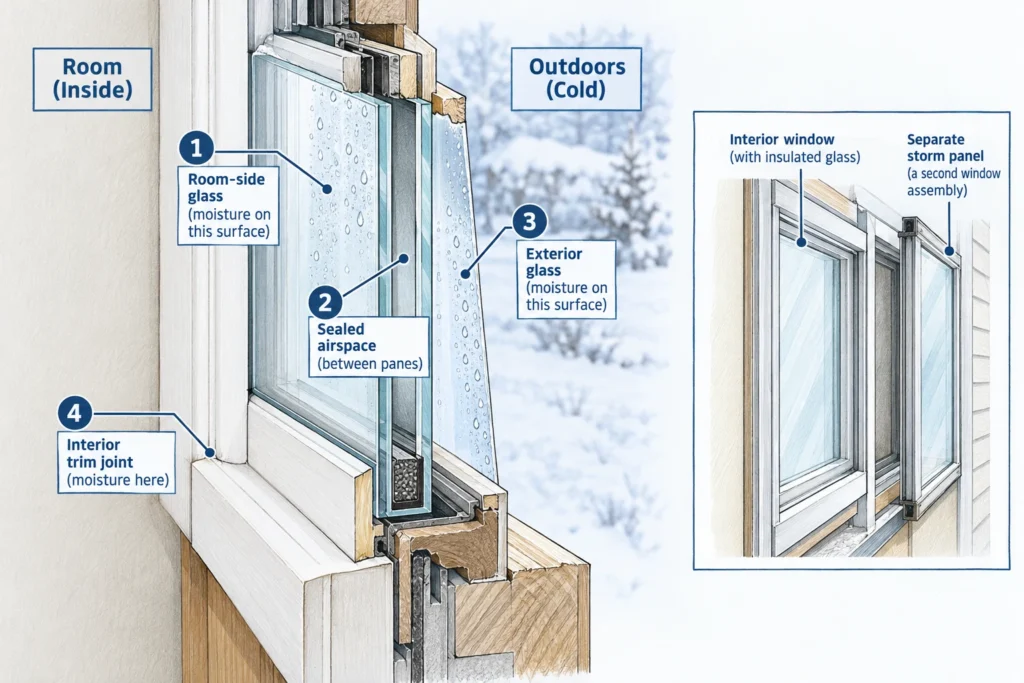
I’m going to imagine that I have a window that is wet enough to soak my sleeve. My first thought is going to be annoyance because I’m going to have to pay to have a new window installed. Before I do that, I’m going to dry up the window and make sure that the moisture didn’t collect there. The puddle of water tells me where the moisture collected, not where it began.
| What you observe | What it suggests | Useful next check |
|---|---|---|
| Room-side droplets after cold nights, sometimes heavier after cooking or showering | Surface condensation | Record room humidity and shade position; watch where droplets return after drying. |
| Fog or droplets within sealed insulating glass that won’t wipe off either exposed face | Deterioration of the insulating-glass perimeter seal | Confirm the assembly type and ask about glass or sash service. |
| Dew on the exterior glass | Exterior surface condensation, not by itself a leak | Distinguish it from water reaching interior trim or walls. |
| Fresh wetting at a trim joint or wall during rain, wind-driven rain, or thawing | Possible water intrusion | Document the first wet location and weather; arrange an enclosure assessment. |
| A wet interior sill with no clear starting point | Condensation runoff, intrusion, or both | Dry the glass and sill separately, then observe where fresh water appears. |
It’s important to know the difference between a failed seal and an air space created by a separate storm panel. Condensation in this space requires a different explanation. Figuring out which construction you have is important before stating the failed double-pane glass.[3]
Your thermostat doesn’t measure the glass
The important temperature here is the glass temperature. The room temperature is irrelevant. The dew point is the temperature at which water vapor starts collecting as liquid and condensation forms. The air in the room can have a high humidity. If there is a large difference in temperature between the outside air and the room air, window condensation can occur. It can also occur if the temperature outside drops below the temperature in the room. A different window can have condensation on it one night and be completely dry the next.[2][5]
Window construction affects glass temperature. The edges of the window can be colder than the center. A difference in temperature can also occur between the center of the window and the perimeter. Droplets at the edge can also occur due to the window being covered with a tightly closed shade or heavy curtain. One of the covered windows can be defective, however, a condensation pocket between the window and the shade is not indicative of a defective window.[3]
EPA recommends keeping the indoor relative humidity below 60%, with the ideal range being 30-50%. I wouldn’t dismiss window droplets just because your indoor relative humidity is below the recommended level. A particularly cold window can still condensate. The workable winter level depends on the outdoor conditions, the room temperature and the window assembly.[1][3][5]
Try a change you can actually learn from
If you're not finding room-side droplets while observing wet wall materials, try a reversible change before searching for problem windows. See if moisture isn’t being added by opening the window covering to let room air contact the glass, or by turning down a humidifier. Bathroom and kitchen exhaust fans help remove moisture at the source. A recirculating kitchen hood doesn’t.[2][3][5]
Use a small hygrometer to record room humidity, along with outdoor temperatures and the position of window shades. Compare how the windows wet when similarly cold nights occur.[1][2][3]
Generally, if there’s less wetting with a change to the circulation of air in the room, that would support the idea of condensation; however, that doesn’t necessarily mean that the opening is watertight. Different changes can work together to solve the problem. For example, both air circulation and dehumidification can help remove moisture from the air.[2][5]
Wet trim deserves more attention than wet glass
Damp frames can collect condensation too, but stained trim, swollen wood, soft drywall, or peeling finishes deserve more attention than droplets alone. Even when condensation runoff is the source, repeated soaking can damage those materials. The name of the moisture problem doesn’t spare the sill.[1][3]
Rain-linked wetting makes me more concerned about intrusion, especially if fresh water emerges at a trim joint before droplets appear on the glass. Photograph the first wet spot and note rain, wind direction, or thawing. That gives an investigator something useful to follow, but it doesn’t identify the entry point: water can travel before you see it, and concealed condensation remains another possibility.[1][7]
Inspect the window sill from ground level. If gutters above the opening are overflowing, debris may be blocking drainage outlets. In some window models, the water drains out through weep holes. Caulking these holes would cause the water to be trapped, and the window sill would rot. If the model of your window has weep holes, you should remove any blockages with a soft brush.[6][7]
Do not let materials of the window trim or wall remain wet. Arrange for a window assessment if the materials do not dry out after being removed. During the assessment, also have the drainage and connection of the window to the wall be examined, as well as the flashing. It may be necessary to leave the stained area of window trim to be assessed as well. Paint may be applied over the stained area, but if water is present behind the paint, it will still be present after the glass dries.[1][7]
Fogged glass isn’t automatically a whole-window purchase
Once water is trapped in sealed insulating glass, more room ventilation won’t remedy the seal. Some models allow glass only replacement; others may require a new sash or other repairs. Most practical repairs depend on the model and the condition of the frame being kept. Fog in the glass does not necessarily mean water is getting into the wall.[4][8]
Prior to approving a window replacement, I would want to know why the current glass is failed and if the replacement also resolves the wet trim. Failed glass and a wet wall may be two separate issues. You shouldn’t have to replace the whole window if failed glass is the only issue.
Sources and references
- U.S. Environmental Protection Agency: A Brief Guide to Mold, Moisture and Your Home
- Andersen Corporation: Condensation on the Interior of Window or Patio Door Glass
- Andersen Corporation: Guide to Understanding Condensation
- Pella Corporation: What Causes Windows to Fog? (2017-11-16)
- U.S. Environmental Protection Agency: Mold Course Chapter 9
- Pella Corporation: Pella Window and Patio Door Owner's Manual
- Building Science Corporation: Info-302: Pan Flashing for Exterior Wall Openings (2013-04-15)
- Andersen Corporation: Reglazing Guide for Andersen Casement and Awning Picture Windows (2006-03-06)