
There could be issues with airflow or overheating causing the furnace to stop and start. The thermostat could also be responding to the overheating, causing the problems. Every few minutes doesn’t tell us which. The first question to ask is, what actually stops? The request for heat? Heat production? Or the circulation blower? I’d work that out before buying a thermostat or agreeing that a new furnace is needed.
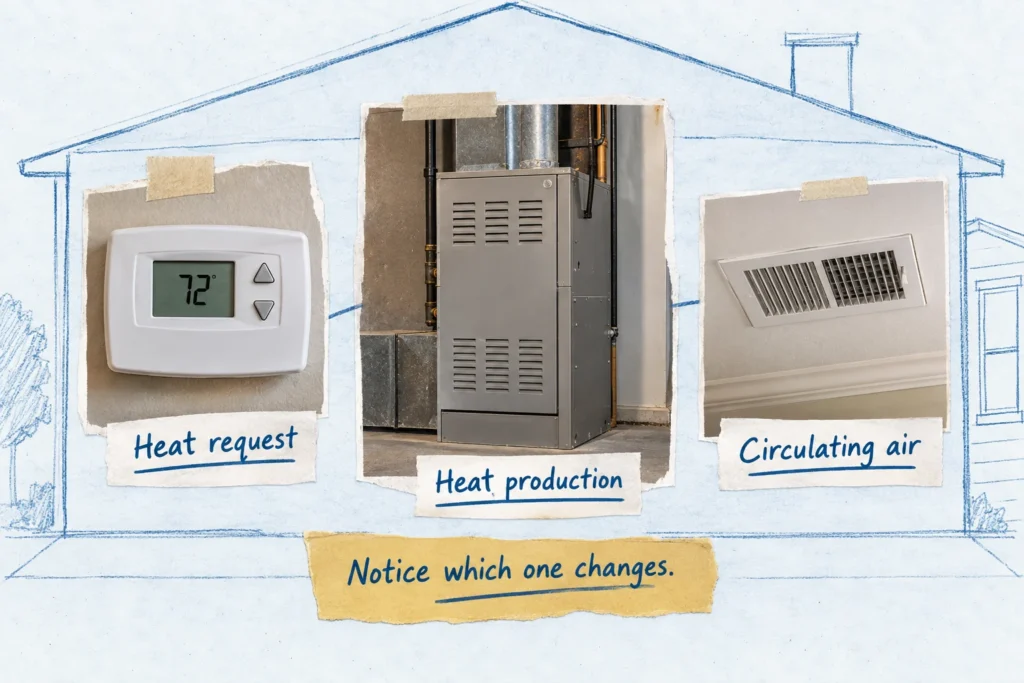
The sound stopping isn’t necessarily the heat stopping
“Short cycling” generally describes repeated brief heating runs, but there’s no universal minute-count cutoff that diagnoses every furnace. Thermostat controls differ by equipment type and heating load. Resideo’s T6 Pro guide, for example, describes equipment-specific cycle-rate settings; a cycles-per-hour setting is not a prescribed burner-on duration. Don’t change installer settings just to stretch the run.
The detailed examples here concern forced-air gas furnaces. Their startup sounds can precede warm air, and their circulating blower can continue after heating ends. On the documented Carrier 59TP6C, stage changes can also alter airflow without ending heat production. Oil furnaces, electric furnaces, heat pumps, and boilers have different sequences; these gas-furnace examples shouldn’t become diagnoses for those systems.
Picture me in an imagined chilly living room, getting up from the couch for the third time because the register has gone cool. I’m annoyed enough to start shopping for a thermostat. Instead, I write down that its heating symbol stayed on while the air lost warmth and the fan kept running. That doesn’t name a failed part, but it gives a service visit a much better starting point than “it keeps turning off.”
| What you notice | What it helps separate | What remains uncertain |
|---|---|---|
| The thermostat’s heating indication ends near the setpoint; the blower continues afterward. | This can fit an ordinary end to heating followed by blower run-on. | The display alone doesn’t prove when the electrical heat request ended. |
| Air loses warmth while the thermostat still appears to request heat; the blower continues. | Heating may be interrupted rather than completed. | Overheating is one possibility, but blower continuation alone doesn’t confirm it. |
| Startup sounds repeat, but sustained warm air never arrives. | This may be failed startup rather than short completed heating runs. | Ignition, vent-related controls, and other faults need model-specific diagnosis. |
| The fan runs between heating periods, especially with fan mode set to On. | Blower operation may be independent of a heat request. | Fan behavior doesn’t establish whether combustion is operating normally. |
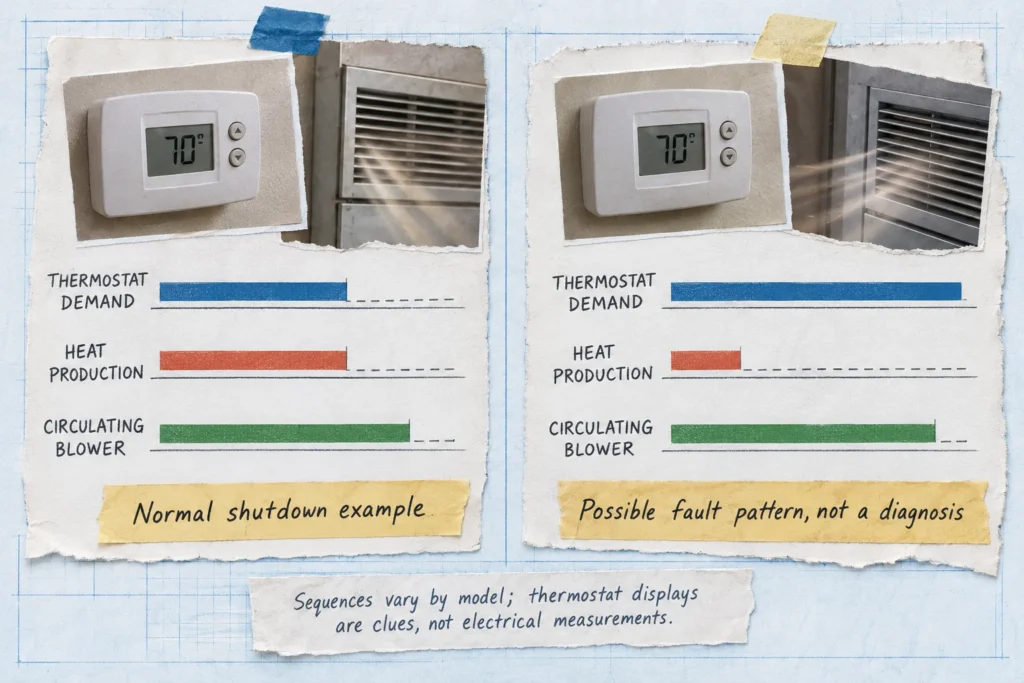
A heating icon is a clue, not an electrical measurement, and a displayed room temperature may be rounded. Likewise, warm air at a register doesn’t reveal combustion quality or heat-exchanger condition. Leave uncertain details marked “unknown.” There’s no reason to remove a furnace panel to make your notes look more complete.
A thermostat problem and an airflow problem stop heat differently
Thermostats may turn off a request for heat if it has been warmed by sunlight or if the surrounding area is too hot. Make sure the setpoint is not too high. Check the schedule and the fan mode. That’s a good control check, and not a reason to relocate or replace it.
restricted air flow results in a different problem, the furnace generates too much heat, and doesn’t remove it. This problem is typically caused by a blocked return or an obstructed filter. The documented Carrier model states that the limit stops combustion and stops the circulating blower in the case of an overheat. This means that the blower will continue to run even after the furnace shuts off. The normal operation of this model may lead one to think that "the fan is still going" after a protective shutdown; however, the blower can also continue to run after the normal completion of a heating cycle.
Change the filter only if your equipment design allows for this type of maintenance. Shut the unit off as directed, and use the proper size, type and direction of the filter airflow. These specifications depend on your design and I would not replace a less restrictive filter as a means of trouble shooting. Do not run the unit without a filter. Don’t remove service panels to access internal components. Move stored items away from returns.
For an observed non-emergency condition document:
Give the service call a useful description
For a nonemergency pattern you can observe without restarting equipment, jot down the following. A short record is enough; you’re not being asked to monitor an unreliable furnace all evening.
- Thermostat settings, display temperatures, heating indication, and the fan mode
- Approximate time to warm air, when warm air stopped, and whether the blower is still running
- Did the home reach the thermostat setpoint and was it too cold
- Do recent changes to the filter, thermostat or equipment affect the behavior
Fault code and model number only if visible without removing the covers
If your system repeatedly loses heat before the house warms, makes repeated failed starts, or goes into protective fault, service is warranted. If the system repeatedly cuts out when heating is apparent demanded, turn the heat off at the thermostat, and don't make further attempts. Loud, possibly booming, ignition or a damaged vent means the furnace shouldn’t be used, and service is warranted. Don't reset the circuit to restore power.
I’d ask the technician if the furnace interrupted the heat cycle and/or if it overheated. If overheating is indicated, ask what the measured temperature across the heat exchanger was compared with the permitted temperature rise, along with airflow and heat-input findings. Not all limit switches are defective. Some Carrier limit-circuit codes cover several protective switches, and a code doesn’t always mean it’s a parts-shopping trip.
A bigger diagnosis needs more than a short run
Oversizing equipment is one possible explanation, not the default verdict. According to DOE, distribution issues and oversizing are some of the concerns during the installation process. If the furnace is suggested to be replaced because it is “too big,” ask for a residential heating load calculation (i.e. ACCA Manual J) and see how it compares to the equipment’s heating output. Runtime alone is not sufficient to establish the case.
Follow regular filter maintenance or repairs that are authorized by code. Watch to see if the home reaches the set point without interruption. Ask the tech to confirm corrected operation and check if model appropriate controls are operating correctly. It is always better if the temperature in the house stays steady instead of having to repeatedly restart the systems to find the set point. But just because the filter is cleaned and system is functioning as designed does not mean that there aren't other combustion or safety issues present. If warmth is needed and the system isn't responding, report this precisely so the location of the issue can be identified as quickly as possible.
Sources and references
- Carrier: 59TP6C Installation, Start-up, Operating and Service and Maintenance Instructions
- Carrier: OM58-131 Gas Furnace Owner's Manual
- Resideo: T6 Pro Smart Thermostat Professional Install Guide
- Vermont Energy Saver: Controls & Thermostats
- U.S. Department of Energy: Purchasing Energy-Efficient Residential Furnaces
- Air Conditioning Contractors of America: Manual J Residential Load Calculation
- U.S. Consumer Product Safety Commission: Carbon Monoxide Fact Sheet
- Carrier: 58TP0A/58TP1A Installation, Start-up, Operating and Service and Maintenance Instructions