
Begin with the water. Is the water level in the basin falling? Is it holding steady or is it rising? If you can get to it safely, check the outdoor outlet. See if there is actual discharge. How a pump is working affects the type of response you give. A pump that is working to remove water from heavy inflow needs a different response from a pump working to remove water from a low level or a pump that is pumping the same water over and over again. I wouldn't buy a replacement pump based on the sound the pump is making.[2][3]
Watch one pumping cycle, if you have dry access
From a dry position, observe a visible basin. Don’t touch anything inside. Don’t open a sealed or unfamiliar cover to get a look. Observe if water is entering from the inlet, if water drops during pumping, what happens after shutoff, and if the float is visible, what it is touching.[2][3]
| What you observe | What it suggests | What to do next |
|---|---|---|
| Long runs; water keeps arriving; level stays controlled; discharge is flowing | The pump may be keeping pace with sustained inflow. | Watch the level trend and compare with weather and previous behavior. Check the actual model’s duty rating. |
| Water drops low, but the pump keeps running | Float interference or a switch fault becomes more plausible. | Stop unnecessary low-water operation using a dry, accessible, unwetted plug or disconnect. Arrange service; don’t reach into the basin. |
| Water stays high or rises; little or no useful discharge | Removal is inadequate. Restriction, freezing, air lock, excessive lift, or a pump fault could explain it. | Seek urgent service if the level is rising. An exterior outlet check may reveal a clue but cannot rule out a hidden blockage. |
| Brief pumping followed by quick refill and restart | Drainback, continuing inflow, exterior recycling, or basin/switch geometry may be involved. | Notice where refill water comes from and inspect the discharge destination. |
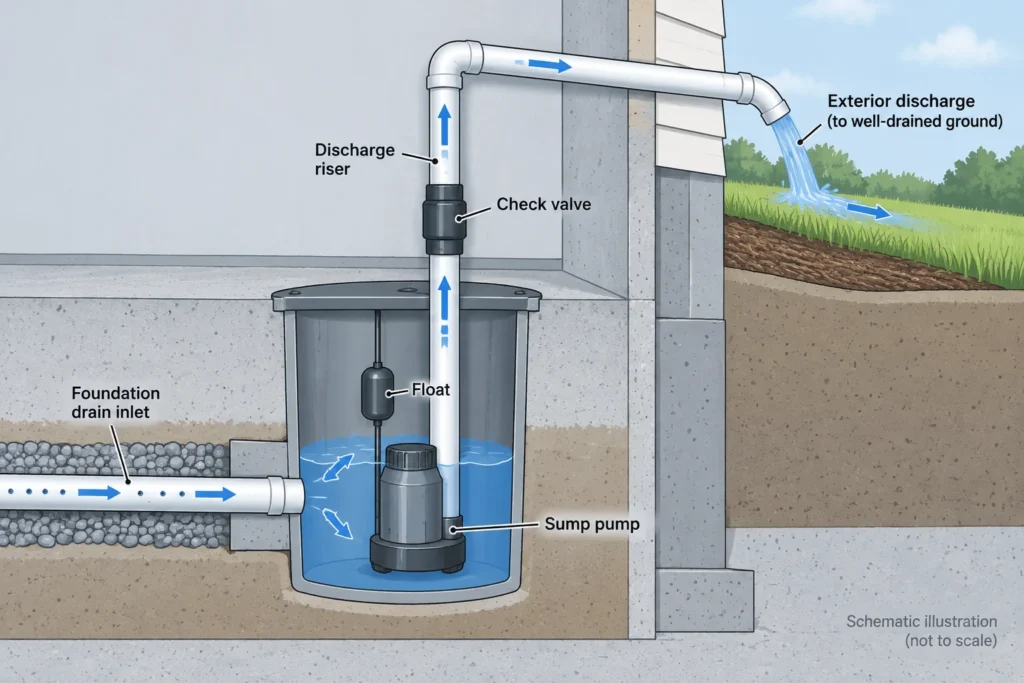
An audible float position is just a clue; it could mean something else is wrong. Humming doesn’t mean the impeller is turning. Stay out of the basin! Don’t bypass the float switch. A backup system could be powered by something other than the main pump, so unplugging the main pump doesn’t make it okay to work on the system.[2][3][7]
Rain explains demand, not every change in behavior
Sustained, incoming water is possible with heavy rain or snowmelt. Groundwater can continue to arrive after the rain stops. There isn’t a set time when the pump must stop running. I’m interested in if this is a known, repeated pattern or if this is new. I’m also interested in if this pump is still controlling the level.[2][4]
Some residential pumps are rated for continuous duty, so nonstop operation of the pump doesn’t necessarily mean the motor is bad. This rating is on a model-by-model basis, and it doesn’t justify pumping without adequate water or removing the water. Pumps controls stormwater and must not be shut off.[2][6]
Follow the discharge, and the water coming back
Look outside for an exposed outlet, hidden by snow or ice. Look for a crushed hose, or water collecting instead of draining away. A blocked or frozen discharge can make a motor look bad because there is no place for the water to go. An open outlet doesn’t clear other blockages in the pipe, like freezing, valve restriction, air lock, or pumping too high. Don’t disassemble a pressurized system and do not use improper methods to thaw.[2][3]
There are two different ways water can come back. Inside the discharge pipe, a missing or leaking check valve can let water fall into the basin after shutoff. Outside, discharge released near the foundation or onto poorly draining ground can soak back toward foundation drains. The first points toward valve investigation; the second points toward discharge routing to a well-drained area sloping away, subject to local discharge requirements.[2][4][5]
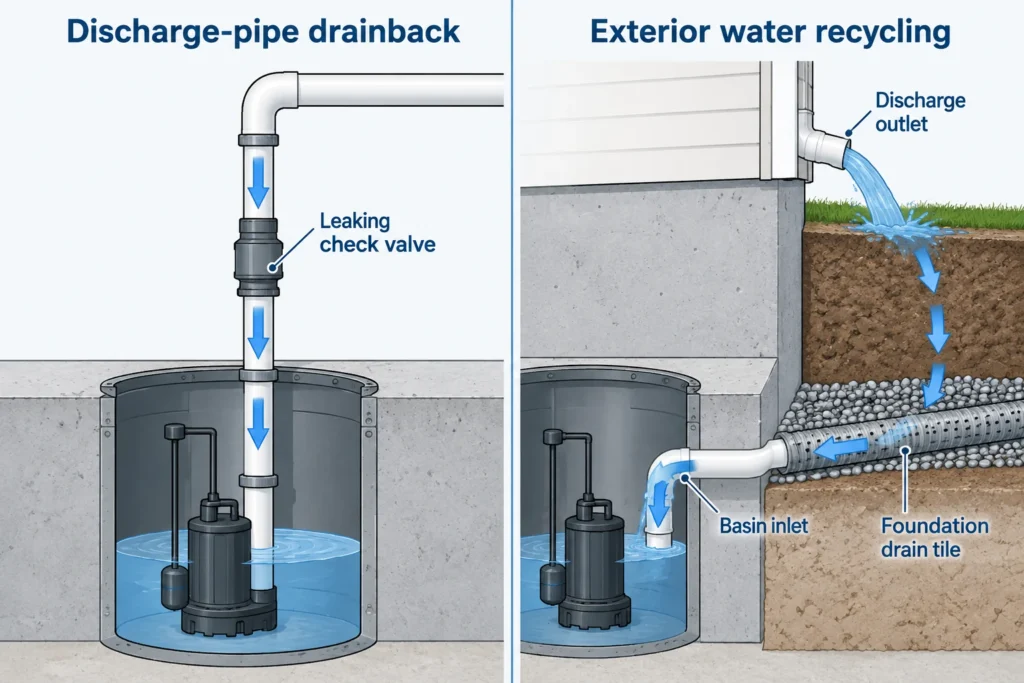
Picture me in an imagined basement, trying to fold laundry while the pump runs for five seconds, pauses fifteen, then starts again. I’m annoyed enough to blame the pump. Instead, I leave everything untouched and watch the refill: water returning down the discharge would send my question toward the check valve; water arriving through inlet drains would keep inflow and outdoor recycling in the picture. Those timings aren’t a diagnostic threshold.[2][4][5]
A clunk after shutoff doesn’t mean the check valve failed. Valve closure can cause water hammer. Short cycling also depends on diameter of the basin and the range of the switch. Some switches aren't adjustable. That’s why I’d resist a generic “raise the float” fix. The right setting for the pump depends on several factors, including the available space in the basin.[5]
Buy protection for the failure you actually face
Consider backup protection if a power outage means losing your pump and quickly flooding your basement. Backup power only works if the pump is still functioning. A battery-operated pump would work as a backup if the primary pump failed, but the battery-operated pump has to match the demand. A bigger horsepower pump doesn’t mean more capacity. Capacity is affected by the resistance of the pipe and the fittings (lift) and is not necessarily reflected by horsepower.[2][3][7]
Be wary of the battery promise given in terms of days. Consider all the factors affecting runtime, the load on the pump, the elevation of the discharge, demand, the condition of the battery, and the weather. Be mindful of the location of the pumps and the pipe discharge and if both pumps share a discharge, adding an additional pump doesn’t help. Ask for a system that has independent discharge.[7]
Some recent weather and the level of the water in your basement is better than "it runs all the time." Behavior such as whether water is continually discharging, the direction of water entering your basment, approximate times of pump run and pause, and if the water level rises and falls are better observations. Ask the technician to test the float operation, and unrestricted discharge capacity of the pump. After repair, check for the change you wanted, such as water being discharged, a shutoff float valve, or a drawdown of the basin level, not merely a quieter basin.[2][3][5]
Sources and references
- Centers for Disease Control and Prevention: Guidelines for Cleaning Safely After a Disaster (2024-04-02)
- Liberty Pumps: S30-Series Installation Manual, 7175000H
- Zoeller Pump Company: Dewatering and Sump Pump Installation Instructions, FM1648
- North Dakota State University Extension: Before the Flood Checklist, DE1567
- Zoeller Pump Company: Product Support, Frequently Asked Questions
- Glentronics / The Basement Watchdog: AC Sump Pumps, Continuous-Duty Guidance
- Liberty Pumps: Model 441 Battery Back-up System Installation Manual, 4414000F