
Outdoor faucets fail in boring, expensive ways. The hose gets left on. The interior shutoff is never tested. A frost-free faucet gets treated like a magic part instead of a faucet that still needs to drain. Then the problem shows up later as damp framing, a stained basement rim joist, or a water bill that suddenly looks off. Outdoor hose bibs are among the pipes most exposed to severe cold, water damage is one of the most common reasons people file home insurance claims, and the EPA says the average family may waste about 9,400 gallons a year from household leaks. (redcross.org)
TL;DR
- Remove every hose, nozzle, timer, splitter, and manifold before freezing weather. Many outdoor faucets, including many frost-free designs, still depend on complete drainage to avoid damage. (pdf.lowes.com)
- If you have an interior shutoff for the outdoor line, close it, open the outdoor faucet to drain, and leave the outdoor faucet open. (redcross.org)
- A foam cover is extra protection, not the main fix. Draining the line matters more than covering the faucet. (pdf.lowes.com)
- If you will be away during cold weather, keep the home heated to at least 55°F. (redcross.org)
- After winter, verify your work with a faucet test, a quick interior inspection, and your water bill. The EPA says that with no outdoor winter water use, a family of four using more than 12,000 gallons in a month likely has a serious leak. (epa.gov)
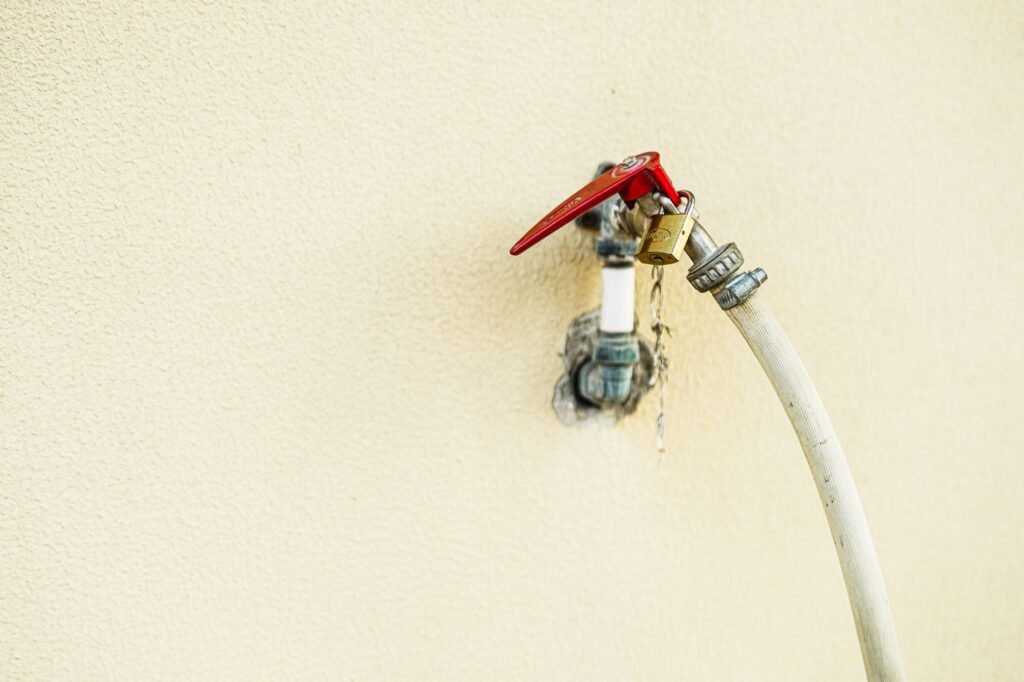
Use the FROST Score first
Assess Your Outdoor Faucet(s) Before Any Purchases. The FROST Score is a fast risk assessment for outdoor faucets. Here are examples of criteria that may have a factor in the Score for your faucet and give you a score with an option of 0 points, 1 point or 2 points for each criteria: Faucet Type, Remove Attachments, Off Valve Inside, Leakage/Damage Drain, And Signs Of Trouble. After these criteria are rated and totalled, the Rating and actions listed below will be determined. Score between 8 and 10 may allow for simple routine seasonal maintenance. Score between 5 and 7 indicates you need to budget for 1 faucet upgrade this year. Score of 4 and lower indicates you may have an active freeze and leak threat opposed to a winter chore.
| Factor | 0 points | 1 point | 2 points |
|---|---|---|---|
| F – Faucet type | You do not know what kind of faucet it is, or the line runs through an unheated wall, garage, crawlspace, or similar cold area. (pdf.lowes.com) | It seems frost-free, but you are not sure the shutoff point is actually in heated space. (pdf.lowes.com) | You know the faucet type and the vulnerable part of the line is protected or has a clear shutoff and drain plan. |
| R – Remove attachments | A hose, nozzle, timer, splitter, or other accessory is still attached. (pdf.lowes.com) | The hose comes off, but add-ons sometimes stay on. | Nothing is attached. The spout is bare. |
| O – Off valve inside | No interior shutoff exists, or it is stuck or untested. | An interior shutoff exists, but you have not verified it works. | You know the valve location and have tested it before cold weather. |
| S – Spill and drain | You did not drain the line, or you rely only on a cover. (pdf.lowes.com) | You drained part of the setup, but you are not confident the line emptied fully. | You shut the inside valve, drained the line, and left the exterior valve open if this faucet uses an interior shutoff. (redcross.org) |
| T – Trouble signs | There are drips, stains, meter movement, or a winter bill jump. (epa.gov) | There is stiffness or a nuisance drip, but no interior evidence yet. | No active leaks, no staining, and bills look normal. |
The 10-minute shut-down before the first hard freeze
- Remove the hose and anything screwed onto the faucet, including spray nozzles, timers, Y-splitters, and manifolds. Those accessories can block drainage or create backpressure. (pdf.lowes.com)
- If the faucet has an interior shutoff valve, close it. Then go outside, open the faucet, let the water drain, and leave the outdoor faucet open. Red Cross guidance specifically recommends leaving the outside valve open so any remaining water can expand without breaking the pipe. (redcross.org)
- If there is no interior shutoff, put a cover on the faucet and insulate any exposed nearby pipe as a short-term step, but treat that as temporary protection rather than a complete solution. (pdf.lowes.com)
- Check the indoor side of the line. Look in the basement, crawlspace, garage, utility room, or behind the wall where the faucet enters the house. If that section is cold, drafty, or obviously vulnerable, move the faucet into your upgrade budget now. (redcross.org)
- Make sure everyone in the house knows where the main water shutoff is and that it actually turns. That matters more than many people think when a line breaks behind a wall. (benbrookwater.com)
- If you are leaving town during winter, keep the heat on and set the thermostat no lower than 55°F. (redcross.org)
- Once the weather warms up, test the faucet with no hose attached before you assume everything survived the season.
Which setup needs what action?
| Your setup | Best move now | Why it matters |
|---|---|---|
| Standard hose bib with a working interior shutoff | Close the inside valve, open the outside faucet to drain, and leave the outside faucet open. Add a cover if you want extra protection. (redcross.org) | This removes trapped water, which is what expands and breaks the pipe when it freezes. (redcross.org) |
| Frost-free sillcock on a heated exterior wall | Still remove the hose and accessories every season. If the faucet drains properly, that may be enough, but using the interior shutoff too is a reasonable extra step when you are unsure. Many frost-free designs still depend on complete drainage. (pdf.lowes.com) | “Frost-free” reduces risk; it does not eliminate the need for drainage. (pdf.lowes.com) |
| Frost-free faucet in a garage wall, crawlspace wall, wing wall, or vacation house | Treat it as high risk. Add an accessible stop-and-waste valve and fully winterize the line. (pdf.lowes.com) | Manufacturer guidance warns that seasonally heated or unheated installations need true winterization, not just a better faucet body. (pdf.lowes.com) |
| Older faucet with no interior shutoff | Use a cover and insulation now, then budget for either an interior shutoff or a full faucet replacement. (pdf.lowes.com) | This setup is more likely to turn a simple freeze into a wall repair because you cannot isolate and drain the line well. |
| A hose, timer, splitter, or shutoff nozzle stays attached all winter | Remove it before the weather turns. Do not leave outdoor accessories under pressure for long periods. (pdf.lowes.com) | Blocked drainage and backpressure are common ways to defeat a frost-resistant faucet. (pdf.lowes.com) |
What this saves: a realistic household example
Consider a simple composite example. A household has two outdoor faucets: one newer frost-free sillcock in back and one older standard faucet in front. In October, they spend $16 on two covers, $14 on pipe insulation, and $240 to have a plumber add an interior stop-and-waste shutoff to the older front line. Total preventive cost: $270.
If they skip that upgrade and the front line splits inside the wall, the cash picture changes fast: $325 for an emergency plumber, $650 for drywall and paint, $500 for drying equipment, and a $1,000 insurance deductible. That is $2,475 out of pocket in this example, before you count time, mess, and the chance that part of the damage is treated as a gradual-leak problem instead of a clean burst-pipe claim. Coverage varies, which is exactly why small preventive work can be such a strong financial decision. (insurance.wa.gov)
Common mistakes that create spring leaks
- Leaving a hose, splitter, timer, or nozzle attached because the faucet is labeled frost-free. (pdf.lowes.com)
- Putting on a foam cover but never draining the line. A cover helps, but it does not remove trapped water. (pdf.lowes.com)
- Not testing the interior shutoff until the day you actually need it. (benbrookwater.com)
- Closing the outside faucet after winterizing an interior-shutoff line instead of leaving room for expansion. (redcross.org)
- Ignoring a small drip or a winter water bill increase because the problem seems minor or outside. Household leaks add up, and gradual leaks are often handled differently by insurance. (epa.gov)
- Assuming a second home, a room over a garage, or a cold wall cavity is protected just because the fixture itself is newer. (pdf.lowes.com)
When a cover is not enough
Some houses beat the basic checklist. Vacation homes, additions with plumbing in wing walls, faucets installed through garage walls, and lines routed through crawlspaces can expose the inlet or supply section to temperatures a simple cover will not solve. Manufacturer instructions for frost-free sillcocks specifically warn that seasonally heated or unheated installations need an accessible stop-and-waste valve for proper winterization. If that describes your home, do not treat the foam cover as the fix. Treat it as a temporary layer while you solve the actual risk. (pdf.lowes.com)
- If the line is in a cold cavity, add or repair an interior stop-and-waste or ball valve so you can isolate and drain the faucet each year. (pdf.lowes.com)
- If the faucet is old and awkward to service, consider replacing it with a properly installed frost-free sillcock sized to the wall thickness. Improper pitch or poor drainage can still cause damage, so installation matters. (pdf.lowes.com)
- If you travel often or own a second home, consider a leak detection or flow-monitoring device. The EPA recommends these systems as a way to catch unintended water use early. (epa.gov)
- If you turn on a faucet during a freeze and only a trickle comes out, suspect a frozen pipe. Use safe thawing methods such as an electric heating pad, hair dryer, or space heater kept away from flammables, and call a licensed plumber if you cannot locate or access the frozen section. (redcross.org)
How to verify you actually fixed the risk
- After the initial cold weather and spring thaw, run all exterior faucets without hoses for 30-60 seconds then inspect the interior side of the same wall (basement rim joist or crawlspace) for drips, dampness in wood or stains.
- Compare your monthly water bill with the same month last year. The EPA says a significant increase can point to an unidentified leak. (epa.gov)
- Do a two-hour meter test: read the water meter when no water is being used, wait two hours, and read again. If the number changes, you probably have a leak. (epa.gov)
- Use the winter threshold as a sanity check. The EPA says that for homes with no outdoor water use in winter, a family of four exceeding 12,000 gallons in a month likely has a serious leak. (epa.gov)
- Turn on utility leak alerts if your water provider offers them. The EPA specifically recommends them as an early-warning tool. (epa.gov)
- If water damage does happen, report sudden leaks quickly to your insurer and stop further damage right away. Delays can complicate claims. (insurance.wa.gov)
Bottom line
The cheapest outdoor faucet repair is usually the one you prevent in October. Strip the faucet bare, drain the line, confirm the shutoff works, and verify later that the wall stayed dry. That routine is simple because the physics are simple: trapped water freezes, expands, and breaks things. And it is financially smart because household leaks already waste thousands of gallons a year, while gradual water problems are often the claims people wish they had understood earlier. (redcross.org)
Warning: This article is for general information, not site-specific plumbing or insurance advice. If the faucet line runs through an unheated cavity, you cannot locate an interior shutoff, you see staining or damp framing, or you suspect a frozen or burst pipe, contact a licensed plumber. If you are counting on insurance, read your policy or ask your agent how frozen-pipe and gradual-leak claims are handled. (redcross.org)
Frequently asked questions
Do I need to winterize a frost-free outdoor faucet?
Usually yes, at least by removing the hose and anything attached to the outlet. Frost-free designs reduce risk by moving the shutoff point inward, but many standard installation instructions still warn that the faucet must drain properly and that a hose left attached in freezing weather can cause damage. (pdf.lowes.com)
Should the outdoor faucet stay open or closed after I shut off the inside valve?
If you used an interior shutoff to winterize the line, Red Cross guidance says to open the outside hose bib to drain it and leave the outside valve open so any remaining water can expand without breaking the pipe. (redcross.org)
Is a foam cover enough by itself?
No. A cover can add protection, and some utilities recommend covering outdoor faucets, but a cover does not replace disconnecting hoses and draining the line when the faucet is subject to freezing. (benbrookwater.com)
What if the faucet only leaks when I turn it on in spring?
Treat that as a possible split in the faucet body or supply tube inside the wall. Shut the interior valve if you have one and stop using the faucet until it is repaired. This is an editorial inference based on how frost-free faucets depend on drainage and how trapped water causes freeze damage. (pdf.lowes.com)
Will homeowners insurance cover damage from a frozen outdoor faucet line?
Often, homeowners insurance covers sudden and accidental water damage, including burst frozen pipes, if the home was heated properly, but gradual leaks are often treated differently. Policy language and insurer practices vary, so check before you assume coverage. (insurance.wa.gov)
How can I tell if I still have a hidden leak after winter?
Start with your water bill and your meter. Compare the bill with the same month last year, then do a two-hour meter test when no water is in use. The EPA says that in winter, with no outdoor water use, a family of four using more than 12,000 gallons in a month likely has a serious leak. (epa.gov)
References
- American Red Cross: Preventing & Thawing Frozen Pipes – https://www.redcross.org/get-help/how-to-prepare-for-emergencies/types-of-emergencies/winter-storm/frozen-pipes.html
- U.S. EPA WaterSense: Statistics and Facts – https://www.epa.gov/watersense/statistics-and-facts
- U.S. EPA WaterSense: Home Maintenance – https://www.epa.gov/watersense/home-maintenance
- Legend Valve Frost-Free Sillcock Installation Instructions (PDF via Lowe’s) – https://pdf.lowes.com/installationguides/662545095097_install.pdf
- Benbrook Water Authority: Tips For Winterizing Pipes – https://www.benbrookwater.com/225/Tips-For-Winterizing-Pipes
- Washington State Office of the Insurance Commissioner: Leaks, Water Damage and Mold – https://www.insurance.wa.gov/insurance-resources/home-insurance/how-home-insurance-works/leaks-water-damage-and-mold