
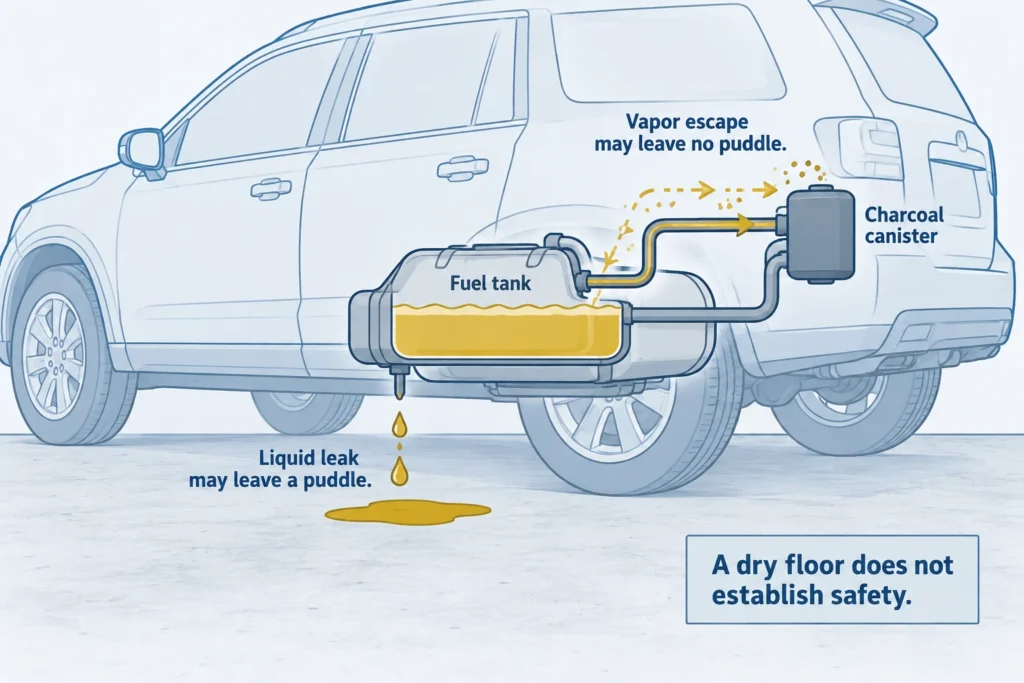
Just because your garage doesn't have a gasoline puddle doesn't mean that gasoline isn't still present. Fuel can still escape as a vapor and accumulate. If the smell is strong and/or getting worse, leave and call for help. Be sure to call from outside.[1][6][7]
Don't operate light switches, the automatic garage-door opener, plug-in fans, or other electrical equipment in the suspect area. Don't start a vehicle or mower, smoke, or use a flame. Motor sparks can ignite gasoline vapor, and vapor can travel to an ignition source and flash back. Getting fresh air means getting yourself outside first, not staying behind to arrange ventilation. Leave emergency ventilation decisions to responders.[2][3][5][6]
A dry floor answers only one question
This doesn't mean there is no liquid fuel release. Gasoline evaporates, and a vehicle can release fuel vapor and odors separately from a liquid leak. Warming fuel creates even more vapor while the vehicle is parked. So, this explains how the odor is produced, but does not explain why we should accept a strong odor as normal.[6][7]
Imagine I'm heading out for groceries when I notice the smell at the garage doorway. My keys are already in my hand, and leaving the car behind feels like an unnecessary snag. Then I catch my assumption: I am starting the engine because I see a clean floor. I put the keys away and leave by another door.
I wouldn't trust my nose to settle the question, either. A stronger or persistent smell adds concern, but odor strength can't tell you whether the concentration is safe. Neither can feeling fine. And what smells like gasoline may be another volatile chemical entirely.[4][6]
After the atmosphere is assessed, match the source to the help
When responders say it is safe to come back to the car, what you do next depends on the source of the odor. If responders say it's safe to go back to the car and you suspect a fuel release, and the fuel is stored in an unwanted container, contact your local household hazardous-waste program. Ask what it takes to dispose of the container and if there are rules about what container you use to transport it. Describe the container to them before you transport it. Don't transport a leaking container in your vehicle.[6][9]
For an equipment item with an engine, such as a mower or a generator, tell the service provider about any changes you remember to fueling, tipping, or storage. Fuel can stay in the tank, and on carbureted models, so can the carburetor. Ask what is leaking or is releasing vapor, and how that machine should be stored. I wouldn't borrow a draining procedure from a different mower. Equipment designs vary.[5]
Paint thinners, degreasers, adhesives and other products used in a garage release volatile compounds. Product names and labels give more information to Poison Control or Fire Officials than the statement, “it smells like gas.” The formulation of a product matters. “Solvent” is not a singular compound.[4]
Not crossing the vehicle off your list may not be a bad idea. There are several vehicles that capture fuel vapor in an activated charcoal canister and later route it to the engine. Faults in that system can release vapor without a puddle. Ask the mechanic to “check for both liquid leaks and evaporative system faults.” Only arrange transport or gain access to the vehicle after the vapor has been cleared. You should not test the engine to see if it starts. I’d like to have a diagnosis before I spent money on a gas cap. Not every vehicle has a removable gas cap.[7]
For future storage the US Fire Administration recommends keeping gasoline and other flammable liquids in a separate storage shed away from your home. That recommendation is for after an incident. If there were flammable liquids near the home, I’d want to know the cause of the release of the vapor and how the repair or disposal of the equipment was addressed. I’d expect less vapor to remain after the equipment has been aired out. If the equipment has not been aired out and the odor returns, leave the area and call again.[1][8]
Sources and references
- City of Somersworth Fire Department: What should I do if I smell smoke or a strange smell in my house or yard?
- New York City Emergency Management: Plan for Hazards, Gas Disruptions
- National Capital Poison Center: Get help for a poisoning
- National Capital Poison Center: What’s that smell?: Identifying unknown fumes in your home
- American Honda Motor Co.: Honda HRM21PVA and HRM21SVA Rotary Mower Owner’s Manual (1990)
- Agency for Toxic Substances and Disease Registry: Gasoline, Automotive, Medical Management Guidelines
- US Environmental Protection Agency: Evaporative Emissions from Onroad Vehicles in MOVES5 (2024-11)
- US Fire Administration: Basement and Garage Fire Safety (2023-04-01)
- King County Hazardous Waste Management Program: Gasoline and fuel disposal