
Water meters can sometimes be hard to read. If the water meter is moving, it could mean water is being used, the display is just changing, or there is a leak. Finding the difference between the three requires knowledge about how the water is being used in the home. I look into equipment that runs on its own first, and then compare the same cumulative reading during a time when no water is being used. This can turn an uneasy look at the water meter into something worth investigating.[1][3][5][6][7]
Picture me in an imagined Saturday-morning check: all of the kids agree not to touch the faucets, and then the refrigerator makes a batch of ice. I’m already uneasy about the water bill and then my controlled test has an asterisk. Rather than blame the pipes behind the wall, I pause the ice maker and restart the test. A quiet kitchen doesn’t mean there is no water use.
First, account for the things that run without you
Leave the supply valves in their ordinary positions for this first check. Closing several at once might hide the very use you’re trying to understand. Instead, pause automatic equipment with its normal controls or choose a time outside its operating cycle. Anything you can’t account for belongs in your notes, not in the “off” column.[10]
- Ice maker: use its dedicated off control, not the refrigerator’s temperature setting. GE also says to turn the ice maker off whenever its water supply is shut off. You don’t need to move the refrigerator for this initial check.
- WATER SOFTENER: Look for an active recharge and verify the regeneration schedule. GE documents a factory-default 2 a.m. start on its equipment, but yours may be set differently. A sleeping household may not be a non-consuming household.
- IRRIGATION: Pause scheduled watering. Look for watering that continues. A malfunctioning valve may allow water to pass with the controller switched off. Pausing the schedule does not physically shut off the water supply.
- PLUMBED WHOLE-HOUSE HUMIDIFIER: Turn off its humidity control. This equipment may take in water and discharge it to a drain automatically. The humidifier may do this without any noise in other areas of the house.
- OTHER EQUIPMENT: Include a pool autofill, automatic filters, and anything else that has a water supply. If you’re not familiar with its control, keep that uncertainty in the system. You haven’t verified zero use.
Read consumption, not just a changing screen
The readings you want are total accumulated volume. Mechanical meters may show total volume with a small flow indicator. A digital meter may cycle through total volume and other information. A changing display may not mean additional water is being consumed. El Dorado Irrigation District’s examples use different units for total volume and flow rate. A total and a flow in gallons per minute may give different information.[3]
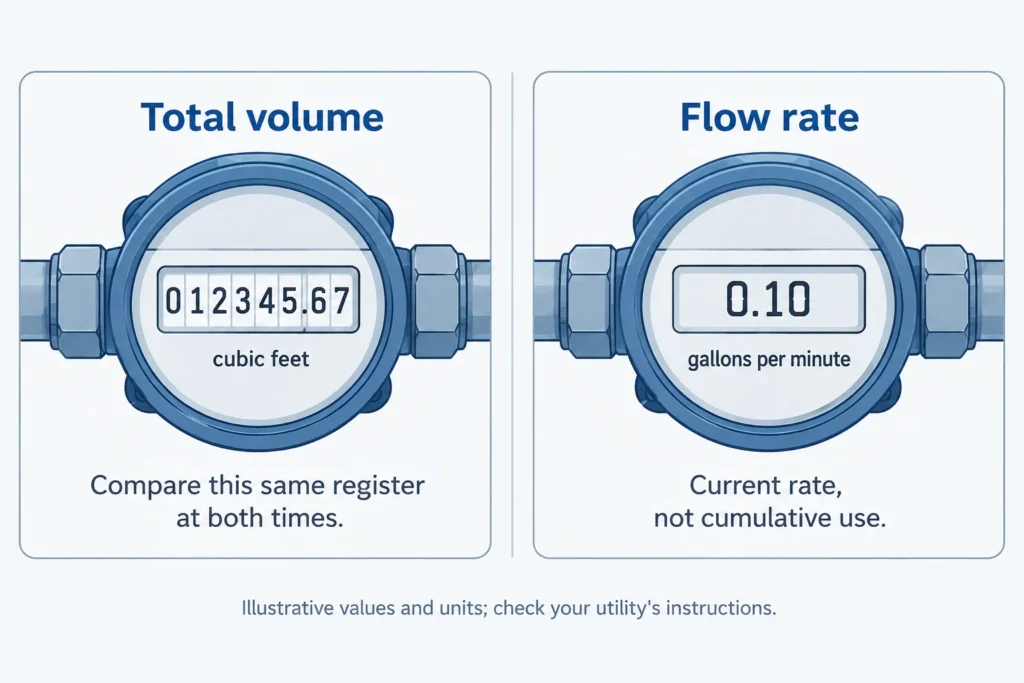
Your utility’s guidance should identify the register, its units, and how many decimal places to use. You also should not have to guess what an icon means, especially since there’s no universal leak symbol or method to activate a display. If you are required to enter an unsafe pit or handle equipment that you are not qualified to operate in order to obtain the reading, do not do this. Leave utility valves alone.[2][3][10]
- Photograph the display with its units and write down the time. Ask everyone to avoid faucets, toilets, dispensers, and water-using appliances.
- Keep a flow indicator in view and decide if its flow is steady, starts and stops, or reverses. Make this observation separately from the total.
- Take a photograph of the same register two hours later, and subtract the total from the previous reading. If someone uses water or an automatic cycle starts during this time, reset the clock and start the 2 hour waiting period again.
If the total decreases and changes during no water use conditions, then your display likely reflects consumption. If the total stays the same, then the resolution of the display isn’t sufficient to detect consumption. The consumed water may have been used upstream of the meter.[1][3][10]
Use an online usage portal for the comparison with caution. It may show older conditions: ACWD, for example, says its portal refreshes every six to eight hours. Check your utility’s interval before assuming the screen displays real-time data.[9]
The movement pattern gives you a clue, not an address
Steady flow with buildup suggests an ongoing source. Intermittent flow might be an automatic fill or a toilet that periodically replenishes water by running the tank to fill. Timing helps you decide what to check, but it can't always tell you if a toilet is malfunctioning. A quiet toilet is worth checking. According to the EPA, you can test a toilet by putting food coloring in the tank and checking the bowl 10 minutes later to see if the color has seeped into the bowl. Be sure to flush to clear the dye.[1][5][6][11]
Back and forth movement requires a different diagnosis. EPA technical guidance suggest changes in pressure and entrapped air as possible causes of bidirectional movement. So if there is bidirectional movement, you should check with the utility to see how their meters measure reverse flow. This movement does not indicate that your meter is defective. I would send a video along with the start and end readings to your utility.[4]
Use shutoffs to narrow the search, not name the leak
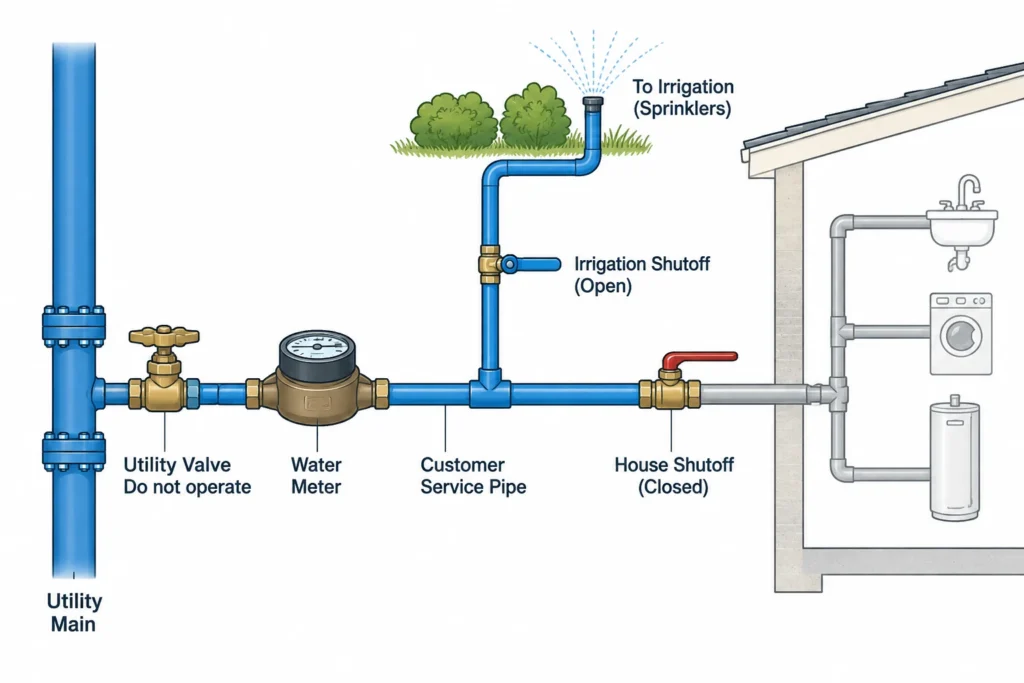
Once you have identified a suspected source, you can test closing one toilet. You should test only a known homeowner-operated valve to see if this eliminates the unexplained flow. You should not force the valve, as this could result in breaking the valve. Leave utility equipment, backflow assemblies, and fire-protection controls alone.[2][9][10][11]
Observe a comparable meter reading after closing the valve. A decrease or stoppage in consumption is indicative of a contribution from the controlled plumbing, assuming the valve closed effectively. It does not indicate a faulty part. For intermittent flow, I would repeat the comparison, and observe the meter again, before reaching a conclusion. It is possible that the equipment didn’t run during the second observation.[2][9][10]
For a house-shutoff test, check whether the valve seals before interpreting the meter. Close the known domestic house shutoff, open a cold faucet, and let residual water subside. If flow continues, the valve hasn’t isolated that plumbing, so this test can’t reliably separate it from other branches. Close the test faucet before watching the meter again.[2]
Consumption that stops with an effectively closed house valve points toward plumbing downstream of it. Consumption that continues points toward piping or branches still supplied. Irrigation can branch off between the meter and that valve, so continued consumption does not automatically identify a buried service-line leak. I’d want the connections and valve condition understood before agreeing to excavation.[2][9][10]
Give the next person something better than “it moves”
If you don’t know the meaning of the display on the meter, whether the meter is on your property, why the arrows on the display reverse, or who owns the service line, contact the utility company first. Ask how quickly the meter register updates and determines your responsibility, and where your responsibility starts. These answers can save you from calling a plumber and having an unnecessary service visit.[2][3][4][9][10]
Persistent, unexplained water consumption, in the absence of an obvious source, requires the services of a plumber or leak detection service to locate the loss. They will typically open up walls or excavate to identify the loss.[2][9][10]
I would provide photos at the start and end of the time period in question, along with readings from the water meters, the status of the equipment (if automated), the movement of equipment, the status of any valves tested (if manual), and whether the valve sealed.
I wouldn't expect the utility to provide this information on their standard form, but rather to capture any of the above mentioned information as part of their records. After repair work is completed, a repeat of the controlled comparison is in order, to verify the supply valves restored to their normal positions and automated use suspended.
Sources and references
- U.S. Environmental Protection Agency WaterSense: Fix a Leak Week (2026-03-13)
- Portland Water Bureau: How to check for leaks
- El Dorado Irrigation District: How to Read Your Meter
- U.S. Environmental Protection Agency: Using Advanced Metering Infrastructure in a Water Quality Surveillance and Response System (2021-02)
- GE Appliances: Water Softener, Water Bypass During Recharge / Regeneration
- GE Appliances: Refrigerator, Icemaker Vacation Setting
- Resideo: Humidifier Homeowner's Manual, 69-2414EFS, 01
- Rain Bird: Watering Even After Turning the Controller Off
- Alameda County Water District: Finding and Fixing Leaks
- West Valley Water District: Leak Detection Guide
- City and County of Broomfield; document credits American Water Works Company: The Water Leak Detection Kit